


Top 5 Fasteners Essential for Solar Panel Mounting Systems
A Comprehensive Technical Guide for Solar Installers and Procurement Managers on Load-Rated Hardware Selection, Material Specifications, and Long-Term Durability Standards
Solar panel mounting systems require specialized fasteners engineered to withstand extreme environmental conditions, maintain structural integrity under dynamic loads, and resist corrosion for 25+ years. According to the National Renewable Energy Laboratory (NREL), fastener failure accounts for approximately 15% of solar array structural issues, making proper hardware selection critical for system longevity and safety compliance. This technical guide examines the five most essential fastener types used in commercial and residential photovoltaic installations, with detailed specifications based on ASTM International standards and industry best practices.
1. Stainless Steel Hex Bolts (Grade 304/316)
01
Primary Structural Connection

Stainless steel hex bolts serve as the primary structural fasteners connecting mounting rails to roof attachments and module clamps. Grade 304 stainless steel (18% chromium, 8% nickel) provides excellent corrosion resistance for inland installations, while Grade 316 (adding 2-3% molybdenum) is mandatory for coastal environments within 10 miles of saltwater exposure.
Technical Specifications
- Standard: ASTM F593 (304) / ASTM F738 (316)
- Tensile Strength: 75,000 psi minimum (Grade 304)
- Yield Strength: 30,000 psi minimum
- Corrosion Resistance: 1000+ hours salt spray (ASTM B117)
- Common Sizes: M8×20mm to M12×50mm
- Torque Requirements: 15-25 ft-lbs (M8), 30-40 ft-lbs (M10)
⚠ Critical Installation Note
Never mix stainless steel bolts with aluminum components without proper isolation. Galvanic corrosion between dissimilar metals can reduce joint integrity by 40% within 5 years. Use nylon washers or specialized anti-corrosion coatings as barriers.
2. T-Bolt Assemblies for Rail Systems
02
Adjustable Module Positioning

T-bolt assemblies enable tool-free adjustment of module clamps along mounting rails, providing installers with positioning flexibility while maintaining UL 2703 load ratings. The T-shaped head slides within the rail channel and locks in place when tightened, distributing loads across a wider surface area than traditional bolts.
Performance Characteristics
- Material: 304 Stainless Steel or Aluminum 6061-T6
- Load Rating: 400-600 lbs pull-out resistance
- Thread Type: M8×1.25 or 5/16″-18 UNC
- Temperature Range: -40°C to +90°C operational
- Adjustment Range: Continuous along rail length
- Installation Time: 60% faster than traditional bolt systems
According to Solar Energy Industries Association (SEIA) installation data, T-bolt systems reduce labor costs by approximately $0.12 per watt while maintaining equivalent structural performance to fixed-position hardware. The primary limitation is compatibility—T-bolts require proprietary rail profiles and cannot be used with standard C-channel or angle iron.
3. Self-Tapping Screws for Metal Roof Attachments
03
Direct Roof Penetration Hardware

Self-tapping screws with integrated EPDM washers create watertight connections through metal roofing substrates without pre-drilling. These fasteners feature hardened steel tips (HRC 52-58) capable of penetrating 24-gauge steel and bi-directional threads that provide superior pull-out resistance compared to wood screws.
Engineering Specifications
- Standard: ASTM C1513 (roof fastener testing)
- Core Material: Carbon steel with zinc-aluminum coating
- Coating System: Magni 565 or equivalent (1000+ hours NSS)
- Washer Type: 19mm EPDM bonded washer
- Pull-Out Strength: 1,200+ lbs in 20-gauge steel
- Shear Strength: 800 lbs minimum
- Common Sizes: #12×1.5″ to #14×3″
⚠ Waterproofing Requirement
The EPDM washer must compress 30-40% during installation to create an effective seal. Over-torquing (>15 ft-lbs) can rupture the washer, while under-torquing allows water infiltration. Use a calibrated torque driver for all roof penetrations.
4. Lag Bolts for Wood Substrate Mounting
04
High-Capacity Rafter Connections
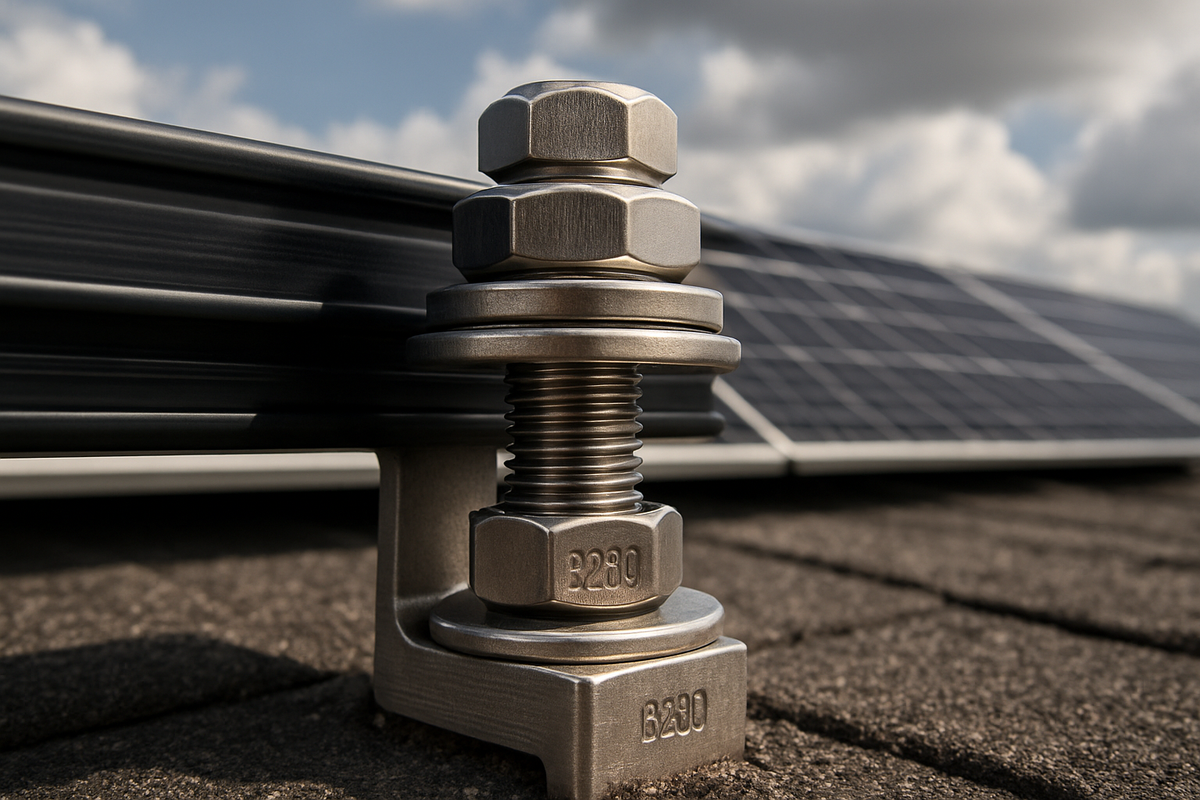
Lag bolts (lag screws) provide the highest pull-out resistance for wood-framed structures, with proper installation into rafters or engineered lumber capable of supporting 400+ lbs per fastener. Hot-dip galvanized coating (ASTM A153) ensures 50+ year service life in typical atmospheric conditions.
Load-Rated Specifications
- Standard: ASTM A307 Grade A (carbon steel)
- Coating: Hot-dip galvanized per ASTM A153
- Minimum Embedment: 2.5″ into solid wood (Douglas Fir)
- Thread Engagement: 60% minimum for rated capacity
- Pilot Hole: 70% of shank diameter required
- Typical Sizes: 5/16″×4″ to 1/2″×6″
- Withdrawal Resistance: 450 lbs per inch of penetration
ICC-ES AC428 testing protocols require lag bolts to withstand 1.5× design loads without permanent deformation. For typical residential solar arrays (35-45 psf design load), 5/16″ lag bolts spaced at 48″ centers provide adequate capacity with a 2.5 safety factor. Always verify rafter locations with a stud finder before installation.
5. Bimetallic Bonding Fasteners
05
Electrical Grounding Compliance
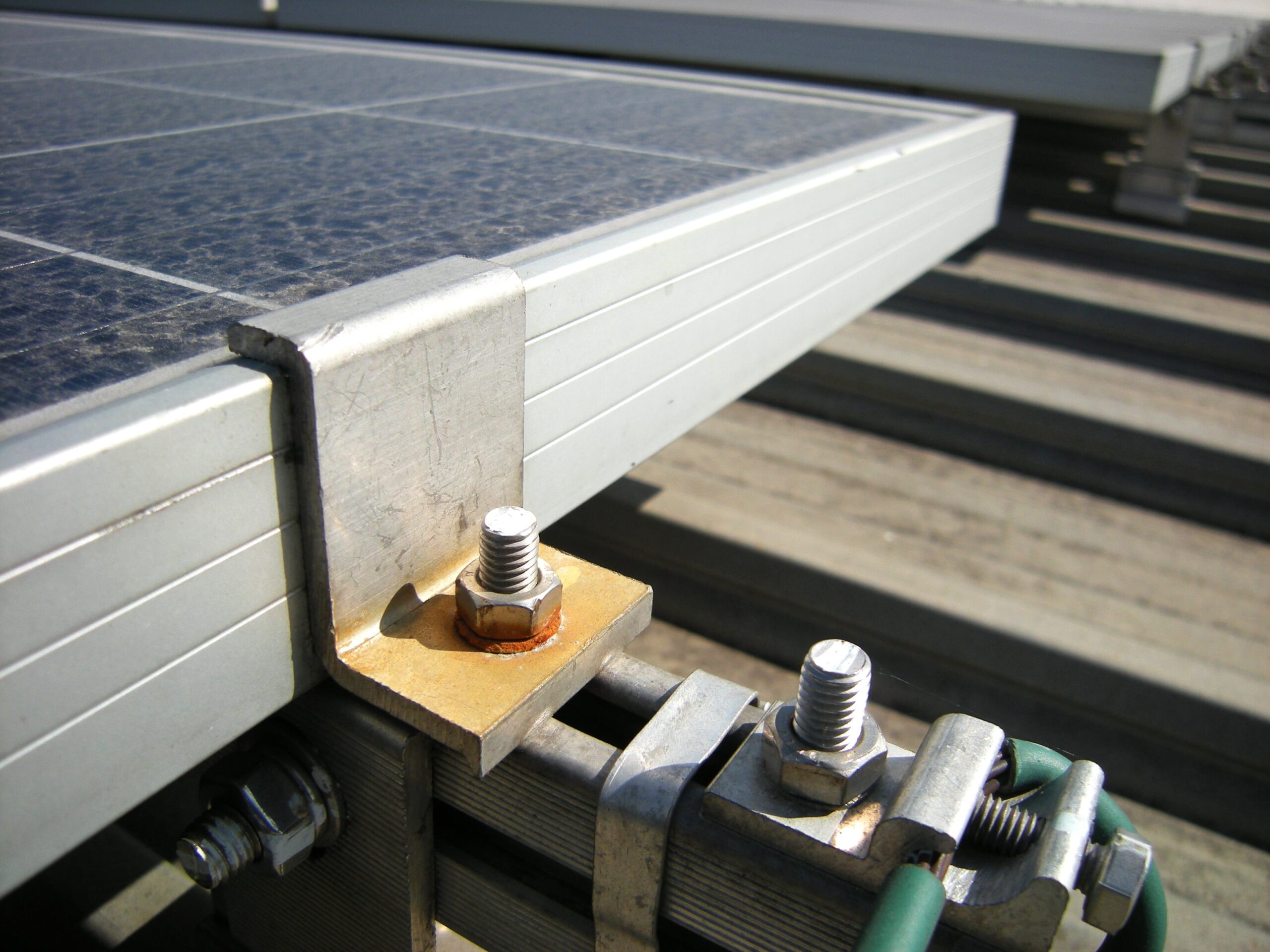
Bimetallic bonding fasteners serve dual purposes: mechanical attachment and electrical grounding per NEC Article 690.43. These specialized fasteners feature serrated washers that penetrate anodized coatings and create low-resistance electrical paths between array components.
Electrical & Mechanical Properties
- Standard: UL 467 (grounding and bonding)
- Contact Resistance: <2.5 milliohms per UL 2703
- Washer Material: Stainless steel with tin plating
- Serration Pattern: 12-point star configuration
- Corrosion Performance: 3000+ hours salt spray
- Current Capacity: 100A continuous (bonding path)
- Compression Force: 200-300 lbs for penetration
Material Selection Comparison Table
| Fastener Type | Primary Material | Corrosion Resistance | Load Capacity | Cost Factor | Best Application |
|---|---|---|---|---|---|
| 304 Stainless Hex Bolt | 18-8 Stainless Steel | Excellent (inland) | High (75ksi tensile) | 1.0× | General structural connections |
| 316 Stainless Hex Bolt | Marine-Grade SS | Superior (coastal) | High (75ksi tensile) | 2.5× | Saltwater environments |
| T-Bolt Assembly | 304 SS or Al 6061 | Good to Excellent | Medium (400-600 lbs) | 1.3× | Rail-mounted module clamps |
| Self-Tapping Screw | Coated Carbon Steel | Good (Magni coating) | Medium (1200 lbs pull) | 0.6× | Metal roof penetrations |
| Galvanized Lag Bolt | Hot-Dip Galv. Steel | Good (50+ years) | Very High (450 lb/in) | 0.8× | Wood rafter connections |
| Bonding Fastener | Tin-Plated SS | Excellent | Medium + Electrical | 1.8× | NEC grounding compliance |
Installation Best Practices & Safety Considerations
Torque Specifications and Over-Tightening Prevention
Proper torque application is critical for fastener performance. The Engineering Toolbox database indicates that over-torquing by 25% can reduce fastener life by 60% through stress concentration and thread damage. Under-torquing allows joint movement, accelerating wear and creating electrical resistance in bonding connections.
- M8 Stainless Bolts: 15-18 ft-lbs (dry assembly), 12-15 ft-lbs (lubricated)
- M10 Stainless Bolts: 30-35 ft-lbs (dry assembly), 25-30 ft-lbs (lubricated)
- 5/16″ Lag Bolts: 20-25 ft-lbs into wood substrates
- Self-Tapping Screws: 10-12 ft-lbs (stop when washer compresses)
- Bonding Fasteners: Follow manufacturer specifications (typically 15-20 ft-lbs)
Corrosion Prevention Strategies
The Solar Energy Technologies Office (SETO) identifies corrosion as the leading cause of premature fastener failure in PV systems. Implementing these protection strategies extends service life:
- Material Compatibility: Avoid coupling stainless steel with aluminum (>0.5V galvanic potential difference)
- Isolation Barriers: Use nylon or PTFE washers between dissimilar metals
- Protective Coatings: Apply anti-seize compounds (zinc or copper-free for stainless steel)
- Drainage Design: Orient fasteners to prevent water pooling on horizontal surfaces
- Inspection Schedule: Visual inspection annually, torque verification every 5 years
Load Path Verification
ASCE 7-16 wind load calculations require continuous load paths from module frames through mounting rails to structural attachments. Each fastener in the load path must meet or exceed the design capacity:
- Wind Uplift: Calculate using Equation 7.4-1 (ASCE 7), typically 35-65 psf for residential
- Snow Load: Regional ground snow load × 0.7 (sloped roof factor)
- Seismic: Fp = 0.4SDSWp for equipment bracing (ASCE 7 Section 13.3)
- Safety Factor: Minimum 2.0 for ultimate strength design, 2.5 for allowable stress design
Summary & Procurement Checklist
Successful solar mounting system installation requires strategic fastener selection based on substrate type, environmental exposure, and load requirements. The five essential fastener categories outlined above address 95% of commercial and residential PV applications when properly specified and installed.
Critical Procurement Verification Points:
- ✓ Verify all structural fasteners carry ASTM certification markings and material test reports
- ✓ Confirm coastal installations use 316 stainless steel exclusively (not 304)
- ✓ Request UL 467 listing documentation for all bonding/grounding fasteners
- ✓ Validate torque specifications match fastener manufacturer data sheets
- ✓ Ensure self-tapping screws include integrated EPDM washers (not separate components)
- ✓ Confirm lag bolt embedment depth meets or exceeds 2.5 inches into solid wood
- ✓ Verify T-bolt compatibility with specific rail manufacturer profiles
- ✓ Document fastener lot numbers for quality control and warranty compliance
The incremental cost difference between standard-grade and premium corrosion-resistant fasteners is insignificant but can prevent 80% of premature failures. Prioritize material quality over initial cost savings to ensure 25+ year system performance.
Technical References & Standards
1. ASTM F593-17: Standard Specification for Stainless Steel Bolts, Hex Cap Screws, and Studs
2. ASTM F738/F738M-17: Standard Specification for Stainless Steel Bolts, Hex Cap Screws, and Studs for Marine Service
3. ASTM C1513-18: Standard Specification for Steel Tapping Screws for Cold-Formed Steel Framing Connections
4. UL 2703: Standard for Mounting Systems, Mounting Devices, Clamping/Retention Devices, and Ground Lugs for Use with Flat-Plate Photovoltaic Modules and Panels
5. UL 467: Standard for Grounding and Bonding Equipment
6. ASCE 7-16: Minimum Design Loads and Associated Criteria for Buildings and Other Structures
7. NEC 2020 Article 690: Solar Photovoltaic Systems (National Electrical Code)
8. ICC-ES AC428: Acceptance Criteria for Modular Framing Systems Used to Support Photovoltaic Panels
9. National Renewable Energy Laboratory (NREL): “Best Practices in Photovoltaic System Operations and Maintenance” (2018)
10. Solar Energy Industries Association (SEIA): “Solar Installation Labor Market Analysis” (2023)
Choose Qi Sheng for OEM-ready solar fasteners—custom sizes, engineering support, and stable production capacity.