

Hot Dip Galvanized (HDG) vs. Zinc Plated Fasteners: Which Do You Need?
A comprehensive technical comparison of coating processes, corrosion resistance, and application-specific selection criteria for industrial fasteners
When selecting fasteners for industrial, construction, or marine applications, the choice between Hot Dip Galvanized (HDG) and Zinc Plated coatings directly impacts service life, corrosion resistance, and total cost of ownership. This technical guide provides engineering-grade data to support informed fastener selection based on environmental exposure, mechanical requirements, and economic considerations.
Both coating methods apply zinc as a sacrificial barrier against corrosion, but differ fundamentally in application process, coating thickness, and protective duration. Understanding these differences is critical for applications ranging from outdoor structural connections to precision electronic assemblies.
Understanding the Coating Processes
Hot Dip Galvanizing (HDG)
Hot dip galvanizing involves immersing cleaned steel fasteners into molten zinc at approximately 450°C (842°F). The process creates a metallurgical bond through diffusion, forming distinct zinc-iron alloy layers beneath a pure zinc outer layer.
Process specifications (per ASTM A153):
- Bath temperature: 445-465°C
- Minimum coating thickness: 45-85 micrometers (depending on steel thickness)
- Coating structure: Multi-layered zinc-iron alloys (Gamma, Delta, Zeta layers) plus Eta pure zinc
- Typical coating weight: 610 g/m² (ASTM A153 Class C for fasteners)
Zinc Electroplating
Zinc electroplating deposits a thin zinc layer through electrolytic deposition in an aqueous zinc salt solution. An electric current reduces zinc ions onto the fastener surface, creating a uniform but thinner coating.
Process specifications (per ASTM B633):
- Operating temperature: 20-40°C (room temperature)
- Coating thickness range: 5-25 micrometers (most common: 8-12 micrometers)
- Coating structure: Pure zinc layer with optional chromate conversion coating
- Service condition classifications: SC1 (very mild) to SC4 (very severe)
Technical Comparison: Key Performance Metrics
| Performance Metric | Hot Dip Galvanized (HDG) | Zinc Electroplated | Engineering Significance |
|---|---|---|---|
| Coating Thickness | 45-85 μm (1.8-3.3 mils) ASTM A153 standard | 5-25 μm (0.2-1.0 mils) ASTM B633 SC1-SC4 | HDG provides 3-17× thicker protection layer |
| Corrosion Resistance (Salt Spray) | 1,000-2,000 hours to 5% red rust (ASTM B117 test) | 96-720 hours to 5% red rust (varies by thickness & chromate) | HDG lasts 3-20× longer in accelerated testing |
| Service Life (Outdoor Exposure) | 20-50+ years (industrial/rural environments) | 1-5 years (requires maintenance or recoating) | HDG suitable for permanent installations |
| Coating Adhesion | Metallurgical bond (zinc-iron alloy layers) Cannot be removed without damaging steel | Mechanical adhesion Can delaminate under stress or impact | HDG provides superior bond strength for structural applications |
| Dimensional Tolerance Impact | ±45-85 μm per side Requires oversized threads (Class 2A/2B minimum) | ±5-12 μm per side Maintains tight tolerances (Class 3A/3B possible) | Zinc plating preferred for precision assemblies |
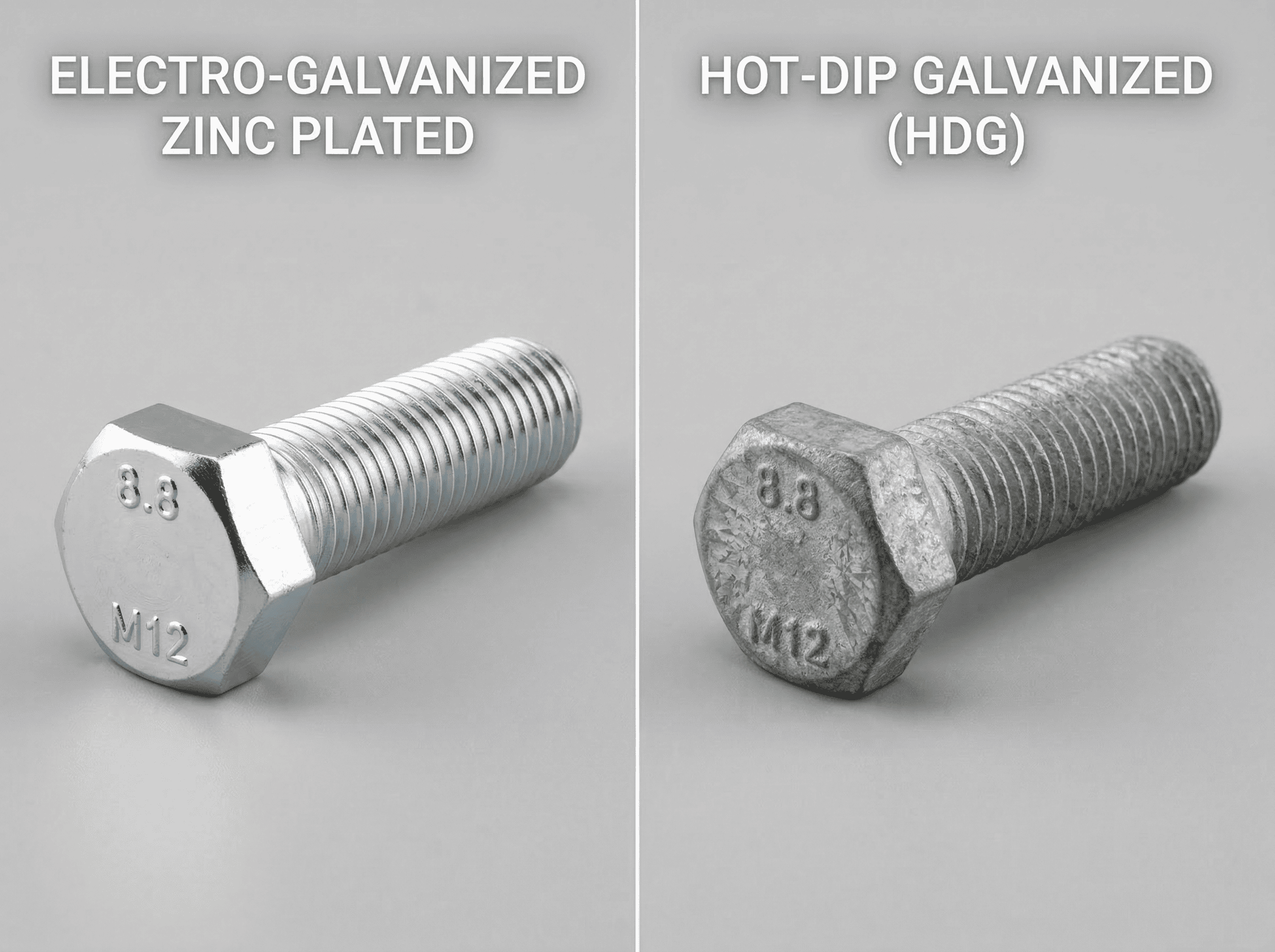
| Surface Finish | Matte gray, spangled appearance Rough texture (Ra 6-12 μm) | Smooth, uniform bright finish Fine texture (Ra 0.5-2 μm) | Zinc plating offers aesthetic advantage for visible applications |
| Hydrogen Embrittlement Risk | Minimal risk (high-temperature process drives out hydrogen) | Significant risk for high-strength steel (≥1,000 MPa) Requires post-bake at 190-210°C | HDG safer for Grade 8.8+ bolts without additional processing |
| Cost (Relative) | Higher initial cost $0.15-0.40 per fastener (typical) | Lower initial cost $0.03-0.10 per fastener (typical) | HDG lower lifecycle cost for long-term outdoor use |
Data Sources: ASTM A153 (Hot-Dip Galvanizing Standard), ASTM B633 (Electroplated Zinc Standard), American Galvanizers Association Technical Reports, ISO 1461 (Hot Dip Galvanized Coatings on Fabricated Iron and Steel Articles)
Corrosion Protection Mechanisms
Barrier Protection
Both coatings provide physical barrier protection, but HDG’s significantly thicker layer (45-85 μm vs. 5-25 μm) extends the time before the underlying steel is exposed. According to the American Galvanizers Association, zinc corrodes at approximately 1 μm per year in rural environments and 2-4 μm per year in industrial/coastal environments.
Rural Environment
HDG: 45-85 years to zinc depletion
Zinc Plate: 5-25 years to zinc depletion
Industrial Environment
HDG: 15-28 years to zinc depletion
Zinc Plate: 2-8 years to zinc depletion
Marine/Coastal Environment
HDG: 11-21 years to zinc depletion
Zinc Plate: 1-6 years to zinc depletion
Galvanic (Sacrificial) Protection
When the coating is scratched or damaged, zinc acts as a sacrificial anode, corroding preferentially to protect the exposed steel. This electrochemical protection continues as long as zinc remains in electrical contact with the steel substrate. HDG’s metallurgical bond ensures continuous electrical contact even if the outer pure zinc layer is compromised, as the zinc-iron alloy layers beneath continue providing protection.
Critical Engineering Note: Galvanic protection radius is limited. For HDG, protection extends approximately 3-6 mm from the coating edge. For zinc plating, the protection radius is typically 1-3 mm. Fasteners with large exposed cut edges (such as drilled holes after galvanizing) may require supplementary protection.
Application-Specific Selection Criteria
When to Specify Hot Dip Galvanized (HDG) Fasteners
- Outdoor structural applications: Building construction, bridges, transmission towers, highway guardrails where 20+ year service life is required
- Corrosive environments: Coastal installations, chemical plants, wastewater treatment facilities, agricultural buildings with ammonia exposure
- High-strength fasteners: Grade 8.8 and above bolts where hydrogen embrittlement risk must be minimized
- Maintenance-free requirements: Applications where accessibility for recoating is limited or prohibited (e.g., embedded anchors, subsea structures)
- Lifecycle cost optimization: Projects where initial cost premium is justified by extended service life and eliminated maintenance costs
- Regulatory compliance: Applications requiring ASTM A153, ISO 1461, or state DOT specifications for galvanized fasteners
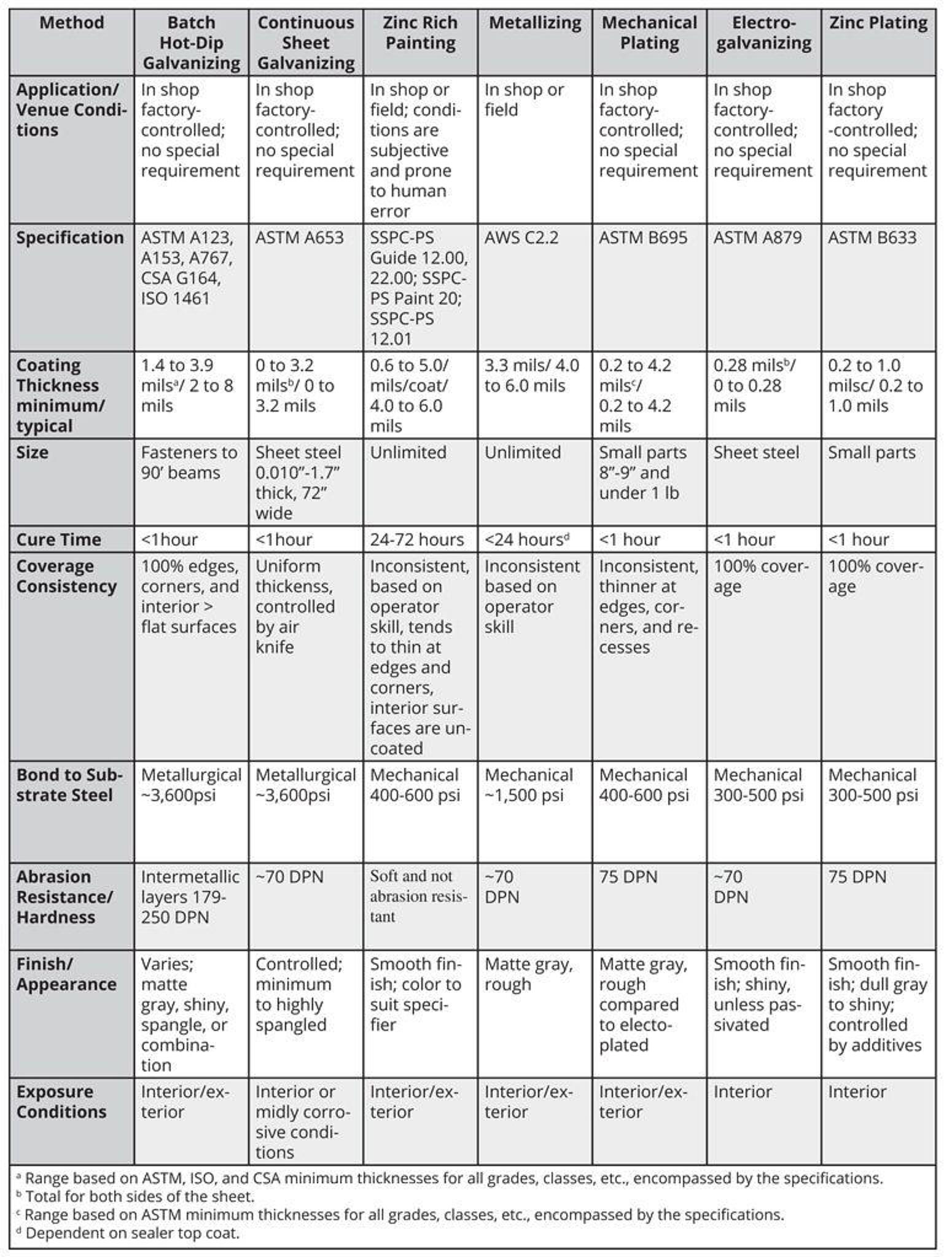
Figure 1: Comparative zinc coating thickness ranges for various application methods (Source: American Galvanizers Association)
When to Specify Zinc Electroplated Fasteners
- Indoor applications: HVAC systems, electrical panels, furniture assembly, interior structural connections with minimal moisture exposure
- Precision assemblies: Electronics enclosures, instrumentation, automotive interior components requiring tight dimensional tolerances (±0.05 mm or better)
- Aesthetic requirements: Visible fasteners where smooth, uniform appearance is specified (architectural hardware, consumer products)
- Short-term outdoor use: Temporary structures, scaffolding, seasonal equipment with 1-3 year expected service life
- Cost-sensitive applications: High-volume consumer products where initial cost drives selection and replacement is economically feasible
- Mating with soft materials: Assemblies involving plastics, composites, or soft metals where HDG’s rough surface could cause galling or damage
Thread Fit and Assembly Considerations
Thread Class Requirements
The coating thickness difference creates critical implications for threaded fastener assemblies:
HDG Thread Requirements
ASTM A153 requires minimum 45 μm coating thickness, adding 90 μm (0.0035″) to the basic thread diameter. This necessitates:
- Minimum Class 2A external threads (bolts)
- Minimum Class 2B internal threads (nuts)
- Overtapped nuts (typically 0.004-0.006″ oversize)
- Pre-galvanizing thread cutting to compensate for coating buildup
Zinc Plated Thread Compatibility
Thin coating (5-12 μm typical) adds only 10-24 μm to thread diameter, allowing:
- Class 3A/3B precision threads possible
- Standard nuts without overtapping
- Post-plating of standard threads
- Direct replacement of uncoated fasteners in existing assemblies
Engineering Reference: ASME B1.1 (Unified Inch Screw Threads), ASTM F2329 (Zinc Coating, Hot-Dip, Requirements for Application to Carbon and Alloy Steel Bolts, Screws, Washers, Nuts, and Special Threaded Fasteners)
Environmental and Sustainability Considerations
Process Environmental Impact
Hot Dip Galvanizing: Energy-intensive process (heating zinc to 450°C) but produces minimal waste. Zinc bath is continuously recycled, and zinc dross (oxidized surface material) is recoverable. No hazardous chemical waste streams. Carbon footprint: approximately 0.8-1.2 kg CO₂ per kg of coated product.
Zinc Electroplating: Lower energy consumption but generates acidic wastewater requiring treatment. Chromate conversion coatings (often applied for enhanced corrosion resistance) contain hexavalent chromium (Cr⁶⁺), a regulated hazardous material. Modern trivalent chromium alternatives reduce environmental impact. Carbon footprint: approximately 0.4-0.6 kg CO₂ per kg of coated product.
End-of-Life Recyclability
Both coating types are fully recyclable with steel. Zinc coatings vaporize during steel remelting and are captured in baghouse dust for zinc recovery. HDG fasteners contain more recoverable zinc due to greater coating mass (0.6-1.2 g zinc per fastener vs. 0.05-0.2 g for zinc plated equivalents).
Quality Control and Standards Compliance
Applicable Standards and Specifications
| Standard | Scope | Key Requirements |
|---|---|---|
| ASTM A153 | Hot-Dip Galvanized Coatings on Iron and Steel Hardware | Minimum coating weight 610 g/m² (Class C for fasteners); adhesion test; uniformity of coating |
| ASTM B633 | Electrodeposited Coatings of Zinc on Iron and Steel | Coating thickness by service condition (SC1-SC4); adhesion; corrosion resistance; appearance |
| ASTM F2329 | Zinc Coating, Hot-Dip, for Threaded Fasteners | Thread fit requirements; coating thickness verification; hydrogen embrittlement testing for Grade 8.8+ |
| ISO 1461 | Hot Dip Galvanized Coatings on Fabricated Iron and Steel Articles | Minimum local thickness 45 μm; average thickness 55 μm; surface condition; adhesion |
| ISO 2081 | Electroplated Coatings of Zinc on Iron or Steel | Thickness designation system; corrosion resistance categories; post-treatment specifications |
| ASTM F1941 | Electrodeposited Coatings on Mechanical Fasteners | Hydrogen embrittlement relief requirements; coating thickness limits for high-strength fasteners |
Inspection and Testing Methods
Coating Thickness Measurement:
- Magnetic induction gauges (ASTM B499) for both HDG and zinc plate
- Microscopic cross-section analysis for precise HDG layer structure examination
- Coulometric methods (ASTM B504) for thin zinc plate coatings
Corrosion Resistance Testing:
- Neutral salt spray (ASTM B117) – industry standard accelerated test
- Cyclic corrosion testing (SAE J2334, GM 9540P) – more realistic automotive/industrial exposure simulation
- Atmospheric exposure testing (ASTM G50) – real-world validation at test sites

Figure 2: Microscopic comparison showing surface texture and coating layer differences between zinc electroplating and hot-dip galvanizing
Common Misconceptions and Clarifications
Misconception 1: “Galvanized and zinc-plated are interchangeable terms.”
Clarification: These are distinct processes with different coating thicknesses and performance characteristics. Using terms interchangeably can lead to specification errors and premature failures.
Misconception 2: “Thicker is always better for corrosion protection.”
Clarification: While HDG provides superior corrosion resistance, excessive coating thickness can cause thread interference, dimensional issues, and increased brittleness in the zinc-iron alloy layers. Coating selection must balance protection requirements with functional constraints.
Misconception 3: “Zinc plating is adequate for all outdoor applications.”
Clarification: Thin zinc plate coatings (5-12 μm) typically provide only 1-3 years of protection in outdoor environments. Applications requiring longer service life without maintenance necessitate HDG or alternative coatings (e.g., zinc-nickel alloy, mechanical galvanizing).
Misconception 4: “HDG fasteners can be painted immediately after galvanizing.”
Clarification: Fresh HDG surfaces require weathering (6-12 months outdoor exposure) or chemical pre-treatment (T-Wash, sweep blasting) to develop sufficient surface profile for paint adhesion. The smooth, pure zinc outer layer has poor paint adhesion without preparation.
Alternative Coating Technologies
When neither HDG nor standard zinc electroplating meets application requirements, consider these alternatives:
Zinc-Nickel Alloy Plating
Electrodeposited coating containing 12-15% nickel, offering 5-10× better corrosion resistance than pure zinc plate while maintaining thin coating thickness (8-12 μm). Preferred for automotive and aerospace applications. Complies with ASTM B841.
Mechanical Galvanizing
Tumbling process that mechanically bonds zinc powder to fastener surfaces, producing 15-50 μm coatings without hydrogen embrittlement risk. Suitable for high-strength fasteners where electroplating risks are unacceptable. Complies with ASTM B695.
Zinc Flake Coatings
Thin (8-12 μm) coatings of zinc and aluminum flakes in an inorganic binder, offering exceptional corrosion resistance (1,000+ hours salt spray) without hydrogen embrittlement. Used extensively in automotive applications. Proprietary systems include Geomet®, Dacromet®.
Stainless Steel Fasteners
For extreme corrosion environments (marine, chemical processing), austenitic stainless steel (304, 316) eliminates coating-related failures. Higher initial cost but indefinite service life in most environments.
Selection Decision Framework
Choose Hot Dip Galvanized (HDG) when:
- Service life requirement exceeds 10 years in outdoor exposure
- Application involves corrosive environments (coastal, industrial, chemical)
- Maintenance access is limited or cost-prohibitive
- Using high-strength fasteners (Grade 8.8+) where hydrogen embrittlement must be avoided
- Lifecycle cost analysis favors durability over initial cost
- Specifications mandate ASTM A153, ISO 1461, or equivalent standards
Choose Zinc Electroplated when:
- Application is primarily indoor or climate-controlled
- Precise dimensional tolerances (Class 3A/3B threads) are required
- Aesthetic appearance (smooth, uniform finish) is specified
- Service life requirement is less than 5 years
- Initial cost minimization is the primary economic driver
- Fasteners will be regularly inspected and replaced as part of maintenance programs
Engineering Recommendation: For critical structural applications with long design life (bridges, buildings, infrastructure), specify HDG fasteners per ASTM A153/F2329. For precision assemblies, indoor equipment, and cost-sensitive consumer products, zinc electroplating per ASTM B633 provides adequate protection at lower cost. When in doubt, consult corrosion engineering specialists and conduct accelerated testing (ASTM B117) to validate coating selection for specific environmental conditions.
References and Further Reading:
1. American Galvanizers Association. (2024). “Corrosion Protection Performance of Hot-Dip Galvanized Steel.” Technical Report.
2. ASTM International. ASTM A153/A153M-16a: Standard Specification for Zinc Coating (Hot-Dip) on Iron and Steel Hardware.
3. ASTM International. ASTM B633-19: Standard Specification for Electrodeposited Coatings of Zinc on Iron and Steel.
4. ISO 1461:2022: Hot dip galvanized coatings on fabricated iron and steel articles — Specifications and test methods.
5. Porter, F.C. (1991). “Corrosion Resistance of Zinc and Zinc Alloys.” CRC Press.
6. Marder, A.R. (2000). “The metallurgy of zinc-coated steel.” Progress in Materials Science, 45(3), 191-271.