

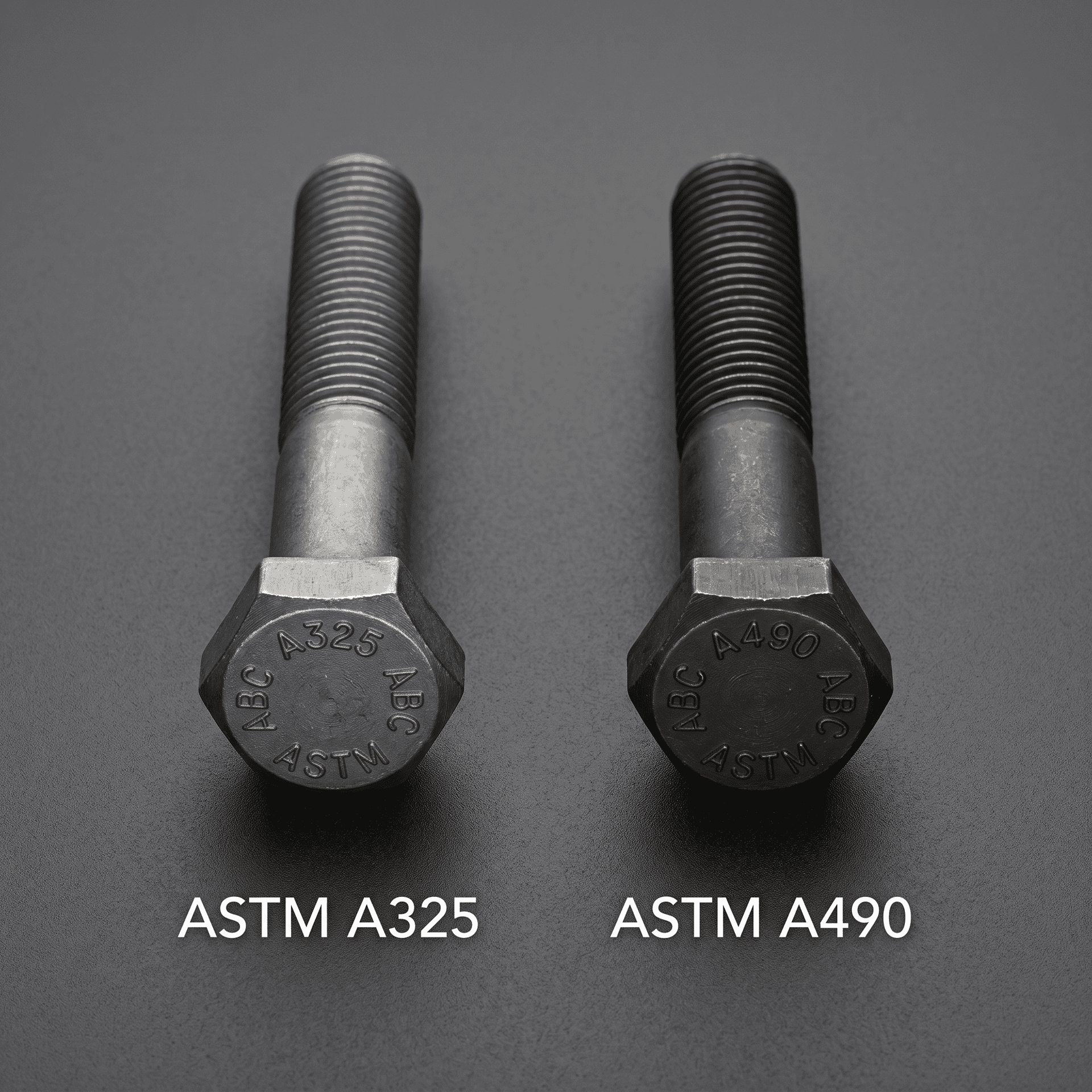
ASTM A325 vs. A490 High Strength Heavy Hex Bolts:
Key Differences, Applications & Selection Guide
When specifying structural fasteners for steel construction, heavy equipment, or infrastructure projects in North America, engineers and procurement managers frequently face the same question: should this joint use ASTM A325 or ASTM A490 heavy hex structural bolts? The wrong selection can lead to under-designed connections, failed inspections, or unnecessary over-engineering that inflates project costs.
This guide provides a factually grounded, side-by-side technical comparison of both bolt grades — covering mechanical properties, material chemistry, surface treatment constraints, application scenarios, and procurement verification requirements — so your team can make the right call every time.
Note: ASTM A325 and ASTM A490 are historically established grades now incorporated under the unified standard ASTM F3125 (Grade A325 and Grade A490 respectively). Both designations remain widely used in engineering specifications and project documents.
Quick Answer
- A325 is a medium-high strength structural bolt (min. tensile 120 ksi for diameters 1-1/2" and under); A490 is ultra-high strength (min. tensile 150 ksi).
- A490 bolts must NOT be hot-dip galvanized (HDG) due to hydrogen embrittlement risk — this is a critical code restriction.
- A325 is significantly more common in standard steel-framed building construction; A490 is used where higher clamping force or smaller bolt diameter is required.
- Both grades use Heavy Hex head geometry for structural connections, paired with specific heavy hex nut grades.
- A325 pairs with ASTM A563 Grade C, DH, or DH3 nuts; A490 pairs with ASTM A194 Grade 2H or A563 Grade DH nuts.
Core Technical Comparison
The table below compares the two grades across the most critical engineering and procurement parameters.
| Parameter | ASTM A325 (F3125 Gr.A325) | ASTM A490 (F3125 Gr.A490) |
|---|---|---|
| Min. Tensile Strength | 120 ksi (diameters up to 1-1/2") | 150 ksi (all diameters) |
| Min. Yield Strength (0.2% offset) | 92 ksi | 130 ksi |
| Material Type | Medium carbon steel or alloy steel | Alloy steel (heat-treated) |
| Hardness Range (Rockwell) | C25 – C34 | C33 – C38 |
| Hot-Dip Galvanizing | Permitted | Prohibited — embrittlement risk |
| Mechanically Deposited Zinc | Permitted | Limited — confirm with standard |
| Plain (uncoated) Finish | Permitted | Standard default finish |
| Head Type | Heavy Hex | Heavy Hex |
| Matching Nut Grade | A563 Gr. C, DH, DH3 | A194 Gr. 2H / A563 Gr. DH |
| Typical Use Case | Standard structural steel framing | High-load or compact joint design |
| Relative Material Cost | Lower | Higher (approx. 20-35% premium) |
| Availability in Market | High — widely stocked | Moderate — often made-to-order |
Mechanical Properties & Engineering Decision Guide
The fundamental distinction between A325 and A490 is mechanical, not geometric. Both bolts share the Heavy Hex head profile, but A490 delivers approximately 25% higher tensile strength, achieved through higher-alloy steel chemistry and controlled heat treatment. This matters in situations where connection geometry is constrained or load demands exceed what an A325 bolt assembly can reliably achieve.
| Decision Factor | Recommended Grade | Technical Reason |
|---|---|---|
| Standard steel-framed building structure | A325 | Sufficient strength for most AISC-compliant moment and shear connections |
| Hot-dip galvanized (HDG) finish required | A325 | A490 must not be galvanized — hydrogen embrittlement risk is code-prohibited |
| High-load connection with limited space for more bolts | A490 | Higher clamping force per bolt reduces required bolt count in congested joints |
| Corrosion-exposed outdoor structural joints (galvanized) | A325 | Only A325 permits HDG; for severe corrosion conditions, verify project specifications |
| Bridge structural connections | A490 | Higher strength reduces fatigue stress range and bolt count in critical joints |
| Budget-sensitive procurement | A325 | Lower raw material and heat-treatment cost; widely available from stock |
| Seismic moment frame (AISC 341 requirements) | Verify with structural EOR | Both grades can appear; specific pretension and inspection requirements apply |
| Heavy equipment foundation bolting | A490 | Higher clamping load resists dynamic vibration loosening more effectively |
Application Scenarios — Where Each Grade Belongs
Understanding which bolt grade is suited to which project type helps engineers and specifiers avoid both over-engineering and under-specification. Below are the typical North American application contexts for each grade.
Best Suited For
- Standard multi-story steel-framed commercial buildings
- Industrial warehouse and manufacturing facility steel frames
- Outdoor structural connections requiring hot-dip galvanized (HDG) finish
- Transmission tower and utility structure bolting
- Standard beam-to-column moment connections
- Projects where fastener stock availability and cost are priorities
- Solar PV racking and support structures
- Agricultural and light industrial steel buildings
Best Suited For
- Long-span bridge structural connections
- Heavy truss and transfer beam joints with congested bolt patterns
- High-rise steel frames with critical column splice connections
- Heavy equipment and machinery base plate anchoring
- Energy sector structural joints — offshore platforms, refineries
- Connections where bolt size must be minimized without sacrificing load
- Seismic-critical moment frames (consult structural EOR and AISC 341)
- Mining and heavy extraction equipment assembly
| Application Scenario | A325 Suitability | A490 Suitability | Notes |
|---|---|---|---|
| Commercial steel building frame | Ideal | Over-specified | A325 is the standard AISC default; A490 rarely needed |
| Bridge structural connections | Acceptable | Preferred | A490 reduces bolt count in critical fatigue zones |
| HDG corrosion protection required | Yes — HDG permitted | No — code prohibited | Galvanizing A490 risks hydrogen embrittlement failure |
| Heavy equipment base plate | Acceptable | Preferred | Higher clamping resists vibration-induced loosening |
| Transmission towers (outdoor) | Ideal | Uncommon | HDG finish requirement makes A325 the practical choice |
| Extreme cold weather (Canada, below -30C) | Verify CVN requirements | Verify CVN requirements | Both grades: confirm Charpy V-Notch toughness with supplier for low-temp service |
| Solar PV racking structure | Common choice | Rarely required | HDG or mechanically plated A325 suits outdoor PV applications well |
| Oil and gas platform / refinery | Project-specific | Often specified | High-load, vibration-heavy environments benefit from A490 clamping force |
Buyer Selection Guide & Supplier Verification Checklist
When procurement managers source high-strength structural fasteners from overseas manufacturers, documentation and traceability are as important as the product itself. In North America, structural fasteners used in code-governed buildings and bridges must comply with AISC, IBC, and RCSC requirements, which mandate proper lot identification and test certification.
Before placing your order, confirm the following with your supplier. Browse our Heavy Hex Bolt Catalog to review available specifications, or Contact Us directly for technical consultation.
When to Choose A325
Choose A325 when your project specifies a standard-grade structural bolt, requires hot-dip galvanized (HDG) surface finish, operates in a cost-sensitive procurement environment, or falls under typical commercial building structural requirements per AISC 360.
When to Choose A490
Choose A490 when joint load demands exceed what a given A325 bolt pattern can carry, when reducing bolt count is critical for geometric or constructability reasons, or when the structural engineer of record has specifically specified Grade A490 in the connection design drawings. Always confirm the coating restriction with your engineer.
| Checklist Item | Why It Matters |
|---|---|
| Mill Test Certificate (MTC) / Material Test Report (MTR) | Proves chemical composition and confirms the heat of steel meets ASTM requirements. Required for code-governed structural use. |
| Mechanical Test Report (Tensile, Yield, Elongation, Hardness) | Verifies that the finished fastener meets minimum strength values per ASTM F3125 Grade A325 or A490. |
| Wedge Load Test (Proof Load) | Confirms that the fastener does not fail below the specified proof load under a wedge configuration — critical for structural bolt compliance. |
| Head Marking / Grade Identification | ASTM F3125 requires specific head markings (e.g., "A325" or "A490" plus manufacturer ID). Absence of marking is a non-conformance. |
| Coating / Surface Finish Confirmation | Confirm whether the finish is plain, mechanically deposited zinc, or HDG — and verify this matches the standard's permitted finishes for the specified grade. |
| Nut Grade Matching Confirmation | Request the nut grade and lot to verify correct pairing (A563 Grade DH for A325; A194 Grade 2H for A490). Mismatched assemblies reduce clamping reliability. |
| Lot / Heat Number Traceability | Structural projects in North America typically require full traceability. Confirm that each shipped carton or pallet carries lot identification. |
| Export Packaging for Ocean Freight | Confirm cartons are packed on pallets with waterproof inner wrap, anti-rust treatment, and weight-compliant labeling for North American port requirements. |
Ready to Source High Strength Heavy Hex Bolts?
QISHENG manufactures ASTM A325 and A490 (F3125) Heavy Hex Structural Bolts for North American structural, industrial, and infrastructure projects. Our export-ready fasteners are supplied with full documentation including Mill Test Certificates, mechanical test reports, and proper head marking — ready for code-compliant structural applications.
- Available grades: ASTM A325 / A490 (F3125) Heavy Hex Structural Bolts
- Finishes: Plain (black), hot-dip galvanized (A325 only), mechanically deposited zinc
- Matching nuts available: A563 Grade C / DH / DH3 and A194 Grade 2H
- Full documentation: MTC, mechanical test report, head marking photos
- Export packaging: Palletized, waterproof inner wrap, anti-rust treatment
- Lead time: Confirm with sales team
- MOQ and custom sizes: Contact our team for project-specific requirements
- Fast RFQ response: Typical quote within 24 business hours