

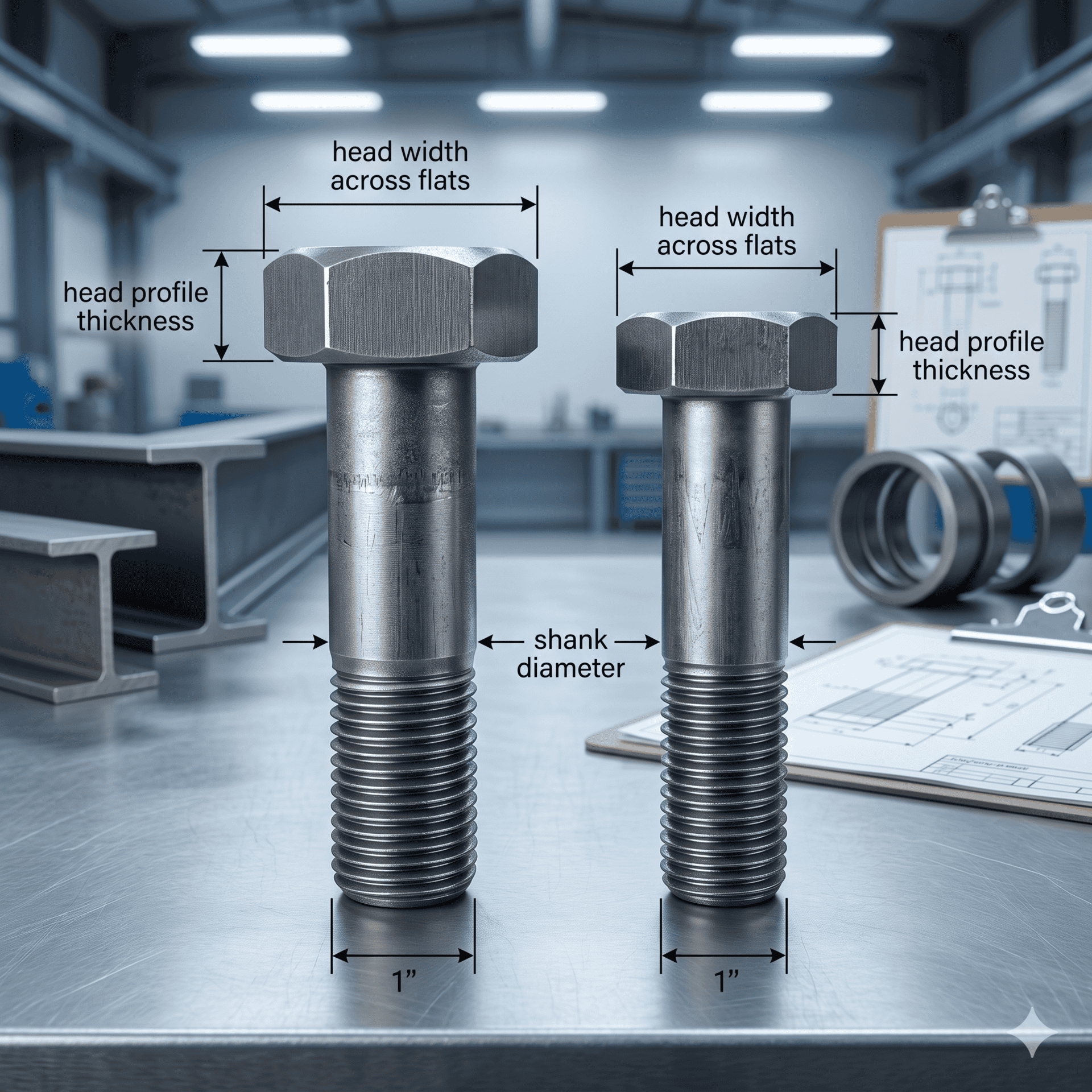
In structural and heavy industrial engineering, selecting the wrong bolt type is not merely a procurement error — it is a structural integrity risk. The difference between a Standard Hex Bolt and a Heavy Hex Bolt may appear subtle to the untrained eye, yet it has direct consequences on bearing surface area, load distribution, clamping force retention, and long-term fatigue resistance under cyclic loading.
This technical guide provides North American structural engineers, project managers, and B2B sourcing managers with a definitive side-by-side comparison of Standard Hex Bolts and Heavy Hex Bolts: their dimensional differences per ASME B18.2.1, their governing ASTM material standards, and the engineering scenarios that demand one over the other.
The Core Comparison: Dimensions, Load Distribution & Material Grades
The distinction between Standard Hex and Heavy Hex fasteners begins at the geometric level. Per ASME B18.2.1, the Heavy Hex series is defined by a wider Width Across Flats (WAF) and a greater head height compared to the standard series of the same nominal bolt diameter. This expanded bearing surface reduces compressive stress on the clamped material — a critical advantage in structural steel, soft metal flanges, and high-temperature applications involving creep.
Standard Hex vs. Heavy Hex: Key Dimensional Differences (ASME B18.2.1)
| Parameter | Standard Hex Bolt | Heavy Hex Bolt | Difference |
|---|---|---|---|
| WAF @ 3/4" Nominal | 1-1/16" (26.97 mm) | 1-5/16" (33.34 mm) | +5/16" wider head |
| WAF @ 1" Nominal | 1-1/2" (38.10 mm) | 1-3/4" (44.45 mm) | +1/4" wider head |
| Head Height @ 3/4" | ~0.480" (12.19 mm) | ~0.604" (15.34 mm) | +26% taller |
| Bearing Surface Area | Lower (smaller contact ring) | Higher (larger contact ring) | +20-30% larger |
| Compatible Nut Series | Standard Hex Nut (ASME B18.2.2) | Heavy Hex Nut (ASME B18.2.2) | Not interchangeable |
| Standard Reference | ASME B18.2.1 | ASME B18.2.1 (Heavy Series) | Same document, distinct tables |
Material Grades and Mechanical Properties
The geometric series (Standard or Heavy) is independent of the material grade, but in practice, Heavy Hex Bolts are most commonly specified in high-strength ASTM grades, while Standard Hex Bolts cover a broader range of commercial grades. The table below shows the most common grade pairings encountered in North American B2B fastener procurement:
| Property | Standard Hex Gr. 5 / Gr. 8 | Heavy Hex A325 / A490 |
|---|---|---|
| Governing Standard | SAE J429 (Grade 5 / Grade 8) | ASTM F3125 (A325 / A490) |
| Min. Tensile Strength | Gr.5: 120 ksi / Gr.8: 150 ksi | A325: 120 ksi / A490: 150 ksi |
| Min. Yield Strength | Gr.5: 92 ksi / Gr.8: 130 ksi | A325: 92 ksi / A490: 130 ksi |
| Proof Load (3/4"-1") | Gr.5: 85 ksi / Gr.8: 120 ksi | A325: 85 ksi / A490: 120 ksi |
| Primary Application | General mechanical assemblies, OEM, machinery | Structural steel connections, bridges, heavy frames |
| Head Series | Standard Hex | Heavy Hex (mandatory for A325/A490) |
| Typical Surface Finish | Plain, Zinc, Hot-Dip Galvanized | Plain (F3125), Hot-Dip Galvanized (F3125M) |
| Installation Method | Standard torque-controlled | Turn-of-nut, Direct Tension Indicator (DTI), or calibrated wrench (AISC) |
For a full dimensional reference of available sizes and configurations, visit our Heavy Hex Bolt Catalog where you can filter by nominal diameter, length, and material grade to match your exact project specification.
Selection Criteria: When Must You Choose High-Strength Heavy Hex?
While Standard Hex Bolts are sufficient for general mechanical assemblies and light structural connections, there are specific engineering scenarios where specifying Heavy Hex Bolts in ASTM A325 or A490 is not just recommended — it is mandated by code, safety, or the physical demands of the application.
AISC 360-22 Specification for Structural Steel Buildings mandates A325 or A490 Heavy Hex Bolts for slip-critical and bearing-type connections in moment frames, braced frames, and column base plates. Standard hex bolts are expressly not permitted in these contexts.
Bridge decks, crane runways, offshore platforms, and seismic-zone steel structures all subject fasteners to cyclic fatigue loading. The higher yield strength of A490 (130 ksi min.) and the increased clamp force from the larger bearing surface of a heavy hex head significantly improve fatigue life and joint integrity.
In petrochemical flanges, boiler structures, and industrial furnace frames, standard bolt grades can experience significant relaxation and creep at elevated temperatures. Heavy Hex Bolts in ASTM A193 B7 or A490 specification maintain clamping force integrity under sustained thermal loading.
When fastening through gypsum board, fiberglass, GFRP panels, or thin aluminum flange faces, the enlarged bearing surface of a Heavy Hex head distributes load across a greater area, preventing localized crushing or pull-through failure that would occur with a standard hex head.
In Canadian coastal construction and offshore North American infrastructure, hot-dip galvanized (HDG) Heavy Hex Bolts per ASTM F3125 and A153 coating ensure corrosion resistance over multi-decade service lives. The heavier head provides additional material for potential corrosion allowance.
AISC requires specific minimum bolt pre-tensions (e.g., 28 kips for 3/4" A325, 35 kips for 3/4" A490). Achieving these pre-tension values through turn-of-nut or DTI methods demands the dimensional precision and material consistency that only certified A325/A490 Heavy Hex Bolts provide.
Frequently Asked Questions
Engineering queries optimized for Google Featured Snippets and long-tail B2B search.
Technically yes — with important caveats. A Heavy Hex Nut has the same internal thread (nominal diameter and thread pitch) as a Standard Hex Nut for the same bolt size, so it will thread onto a standard bolt shank without issue. However, the combination is not recommended for structural applications because the engineer-specified joint design relies on the full clamping system — bolt head bearing surface, nut bearing surface, and pre-tension load path — being consistent. Mixing standard hex bolts with heavy hex nuts (or vice versa) disrupts the bearing area calculation and may not satisfy the AISC pre-tension requirements per the governing specification. Always match the nut series to the bolt series as specified in the design drawings.
No — "heavy hex" refers to geometry, not strength grade. The terms "standard hex" and "heavy hex" describe the head size series as defined by ASME B18.2.1 — specifically the Width Across Flats (WAF) and head height. A Heavy Hex Bolt can be manufactured in low-strength grades (e.g., SAE Grade 2, ASTM A36), and a Standard Hex Bolt can be made in high-strength grades (e.g., SAE Grade 8). The reason Heavy Hex Bolts are strongly associated with high strength is practical: ASTM F3125 (which governs A325 and A490 structural bolts) specifically requires the heavy hex head geometry. So while "heavy hex" does not inherently guarantee higher strength, in North American structural engineering practice, the presence of a heavy hex head is a reliable indicator that a high-strength ASTM structural grade is intended. Always verify the grade marking on the bolt head (e.g., "A325" or "A490" markings per ASTM F3125).
Width Across Flats (WAF) is the measurement across the two parallel flat faces of a hex bolt head or nut — the dimension that determines which wrench or socket size is required for installation. Per ASME B18.2.1, for the same nominal bolt diameter, Heavy Hex Bolts have a larger WAF than Standard Hex Bolts. For example, a 3/4" diameter Standard Hex Bolt requires a 1-1/8" wrench, while a Heavy Hex Bolt of the same shank diameter requires a 1-5/16" wrench. In B2B fastener procurement, specifying WAF incorrectly can cause field installation failures because field crews may not have the correct tooling. When ordering in bulk for a structural project, always specify both the nominal diameter and the head series (Standard or Heavy) in your purchase order — and confirm that your installation contractor has the matching wrench sizes on site. For bulk-order support and dimensional verification, our team can assist directly.
How to Order / Quick Specs
| Specification Parameter | What to Provide When Ordering |
|---|---|
| Nominal Diameter | E.g., 3/4", 7/8", 1", 1-1/8", 1-1/4" (Imperial) or M20, M22 (Metric) |
| Length (Grip + Thread) | Total shank length in inches or mm; specify full-thread or partial-thread if required |
| Head Series | Standard Hex or Heavy Hex (per ASME B18.2.1) |
| Material Grade | ASTM A325 / A490 / A193 B7 / SAE Grade 5 or 8 |
| Surface Finish | Plain, Hot-Dip Galvanized (HDG), Mechanically Galvanized, Black Oxide |
| Quantity | Pieces (pcs) or weight (kg/lbs); minimum order quantities available on request |
| Documentation | Mill Test Reports (MTRs), ASTM Certification, AISC compliance letters available |
Ready to Source Your Next
Structural Bolt Package?
QISHENG supplies Heavy Hex Bolts in ASTM A325 and A490 to structural steel contractors, fabricators, and EPC firms across North America. Our in-house manufacturing supports bulk orders with full ASTM traceability, MTRs, and rapid lead times. Whether your project requires 5,000 pieces or 500,000 pieces, our engineering sales team will review your spec sheet and provide a competitive, code-compliant quote within 24 hours.