

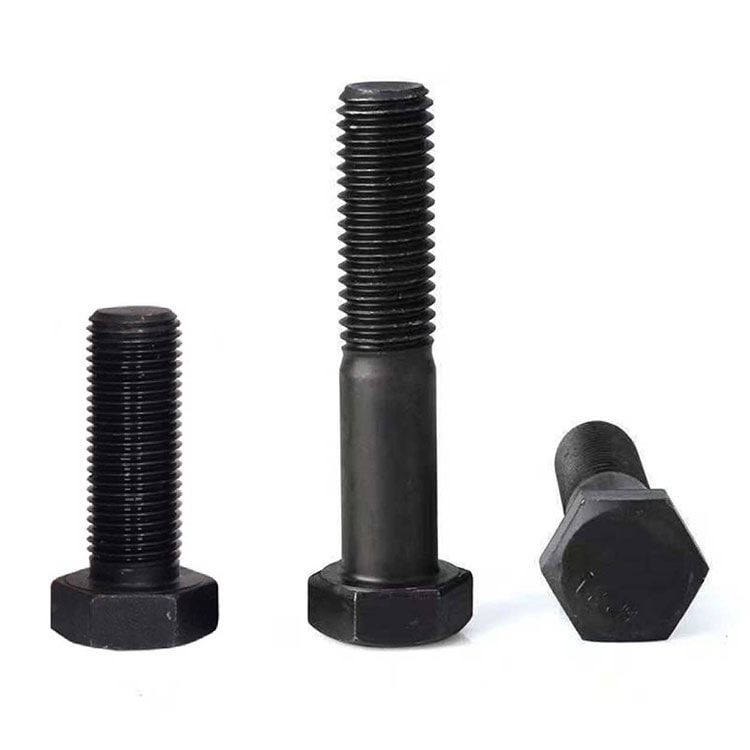
ASTM A193 B7 vs ASTM A320 L7: What Is the Difference?
A Comprehensive Technical Comparison for Engineering and Procurement Professionals
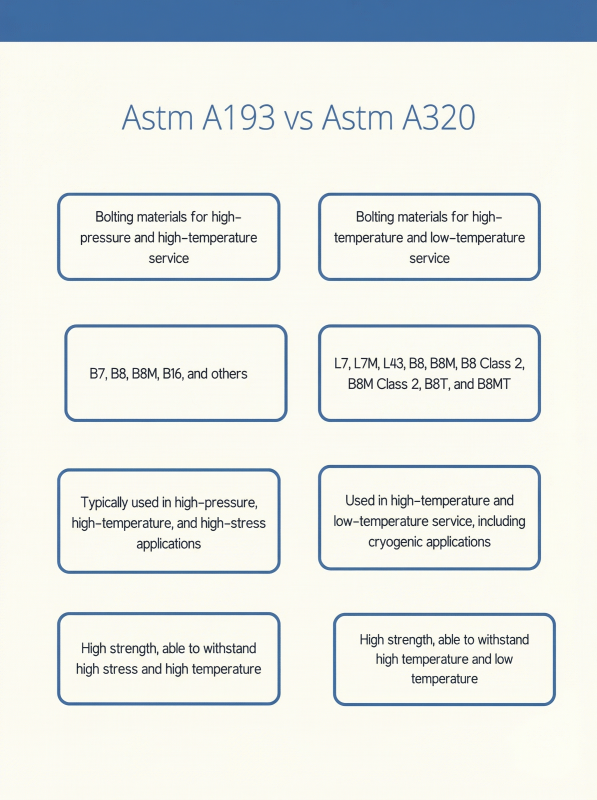
Executive Summary: ASTM A193 B7 and ASTM A320 L7 are both chromium-molybdenum alloy steel fasteners with nearly identical chemical compositions and mechanical properties. However, the critical distinction lies in their qualification for low-temperature service. ASTM A320 L7 requires mandatory Charpy V-notch impact testing at -46°C (-50°F), making it the specification of choice for cryogenic applications, pressure vessels, and piping systems operating below -29°C (-20°F). This article provides a detailed technical comparison to guide material selection for critical bolting applications.
Understanding ASTM A193 B7: The Industry Standard for High-Strength Bolting
ASTM A193 is the specification for alloy-steel and stainless steel bolting materials for high-temperature or high-pressure service, and for other special purpose applications. Grade B7, the most widely used grade within this specification, is manufactured from chromium-molybdenum alloy steel (AISI 4140 or 4142 modified).
Key Characteristics of ASTM A193 B7
- Material Composition: Chromium-molybdenum alloy steel with 0.37-0.49% carbon, 0.75-1.20% chromium, and 0.15-0.25% molybdenum
- Heat Treatment: Quenched and tempered to achieve specified mechanical properties
- Tensile Strength: Minimum 125,000 psi (860 MPa) for sizes up to 2.5 inches
- Yield Strength: Minimum 105,000 psi (725 MPa)
- Temperature Range: Suitable for service temperatures from -29°C to 454°C (-20°F to 850°F)
- Applications: Pressure vessels, piping flanges, valve bonnets, and general high-pressure/high-temperature bolting
ASTM A193 B7 is the workhorse of industrial fasteners, specified in ASME B31.3 (Process Piping), ASME Section VIII (Pressure Vessels), and countless other engineering codes. Its popularity stems from excellent mechanical properties, wide availability, and cost-effectiveness.
Understanding ASTM A320 L7: The Low-Temperature Service Specification
ASTM A320 is the specification for alloy-steel and stainless steel bolting materials for low-temperature service. Grade L7 is essentially the low-temperature equivalent of ASTM A193 B7, manufactured from the same chromium-molybdenum alloy steel base material.
Key Characteristics of ASTM A320 L7
- Material Composition: Identical to A193 B7 (chromium-molybdenum alloy steel)
- Heat Treatment: Quenched and tempered with specific controls for low-temperature toughness
- Tensile Strength: Minimum 125,000 psi (860 MPa) for sizes up to 2.5 inches
- Yield Strength: Minimum 105,000 psi (725 MPa)
- Temperature Range: Qualified for service temperatures down to -46°C (-50°F)
- Impact Testing: Mandatory Charpy V-notch testing at -46°C (-50°F) with minimum 20 ft-lbf (27 J) average
- Applications: LNG facilities, cryogenic storage, cold climate installations, and any low-temperature pressure equipment

ASTM A193 B7 Stud Bolt
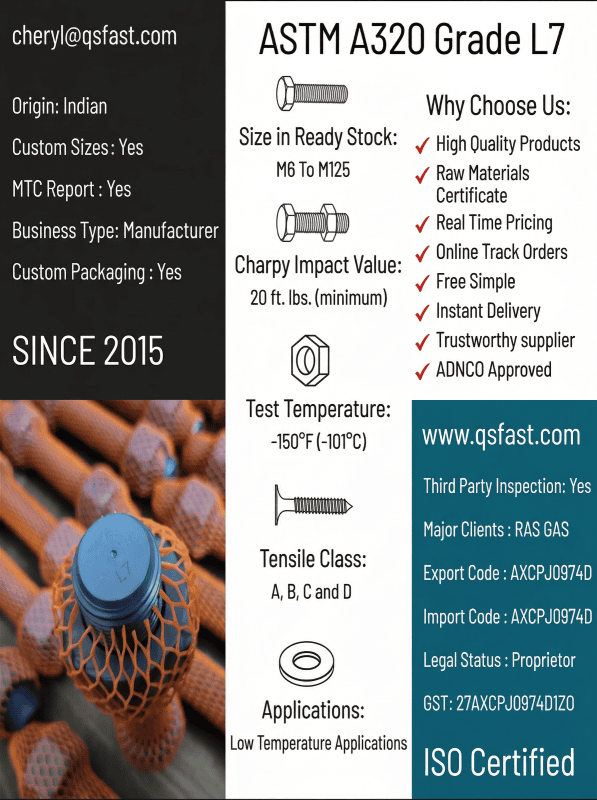
ASTM A320 Grade L7 Stud Bolt
The Critical Difference: Impact Testing Requirements
The fundamental distinction between ASTM A193 B7 and ASTM A320 L7 is not in their chemical composition or room-temperature mechanical properties—these are virtually identical. The critical difference is the mandatory Charpy V-notch impact testing required for A320 L7.
Why Impact Testing Matters: At low temperatures, steel can undergo a ductile-to-brittle transition, meaning it becomes more susceptible to sudden fracture without significant deformation. Impact testing verifies that the material maintains adequate toughness (energy absorption capability) at the specified low temperature. ASTM A320 L7 must demonstrate a minimum of 20 ft-lbf (27 Joules) average impact energy at -46°C (-50°F), ensuring the fastener will not fail catastrophically in cold service.
ASTM A193 B7, while suitable for temperatures down to -29°C (-20°F) per ASME codes, does not require impact testing. This means its low-temperature toughness is not verified, making it unsuitable for applications below its minimum rated temperature.
Detailed Technical Comparison: ASTM A193 B7 vs ASTM A320 L7
| Property/Requirement | ASTM A193 B7 | ASTM A320 L7 |
|---|---|---|
| Base Material | Chromium-Molybdenum Alloy Steel | Chromium-Molybdenum Alloy Steel |
| Carbon Content (%) | 0.37 – 0.49 | 0.37 – 0.49 |
| Chromium Content (%) | 0.75 – 1.20 | 0.75 – 1.20 |
| Molybdenum Content (%) | 0.15 – 0.25 | 0.15 – 0.25 |
| Tensile Strength (≤2.5″) | ≥125,000 psi (860 MPa) | ≥125,000 psi (860 MPa) |
| Yield Strength (≤2.5″) | ≥105,000 psi (725 MPa) | ≥105,000 psi (725 MPa) |
| Elongation (%) | ≥16% in 2 inches | ≥16% in 2 inches |
| Reduction of Area (%) | ≥50% | ≥50% |
| Hardness Range | HBW 235-321 (HRC 23-35) | HBW 235-321 (HRC 23-35) |
| Impact Testing Required | No | Yes – Mandatory |
| Impact Test Temperature | Not Applicable | -46°C (-50°F) |
| Minimum Impact Energy | Not Applicable | 20 ft-lbf (27 J) average |
| Minimum Service Temperature | -29°C (-20°F) | -46°C (-50°F) |
| Maximum Service Temperature | 454°C (850°F) | 454°C (850°F) |
| Heat Treatment | Quenched & Tempered | Quenched & Tempered |
| Typical Applications | General high-pressure/high-temperature service | Low-temperature pressure equipment |
| ASME Code Recognition | ASME B31.3, Section VIII | ASME B31.3, Section VIII (for low-temp) |
| Relative Cost | Standard | 10-25% premium due to impact testing |
Chemical Composition and Metallurgical Equivalence
Both ASTM A193 B7 and ASTM A320 L7 are manufactured from the same base alloy steel, typically corresponding to AISI 4140 or 4142 modified. The chemical composition requirements are identical per the respective specifications:
ASTM A193 B7 Chemistry
- Carbon (C): 0.37 – 0.49%
- Manganese (Mn): 0.65 – 1.10%
- Phosphorus (P): 0.035% max
- Sulfur (S): 0.040% max
- Silicon (Si): 0.15 – 0.35%
- Chromium (Cr): 0.75 – 1.20%
- Molybdenum (Mo): 0.15 – 0.25%
ASTM A320 L7 Chemistry
- Carbon (C): 0.37 – 0.49%
- Manganese (Mn): 0.65 – 1.10%
- Phosphorus (P): 0.035% max
- Sulfur (S): 0.040% max
- Silicon (Si): 0.15 – 0.35%
- Chromium (Cr): 0.75 – 1.20%
- Molybdenum (Mo): 0.15 – 0.25%
The chromium and molybdenum alloying elements provide hardenability, strength, and corrosion resistance. The identical chemistry means that a heat of material could theoretically meet both specifications—the determining factor is whether it passes the impact testing required for A320 L7.
Mechanical Properties: Room Temperature Performance
At room temperature (approximately 20°C/68°F), ASTM A193 B7 and ASTM A320 L7 exhibit identical mechanical properties. Both specifications require:
- Tensile Strength: Minimum 125,000 psi (860 MPa) for diameters up to 2.5 inches, with slightly reduced requirements for larger sizes
- Yield Strength: Minimum 105,000 psi (725 MPa) for diameters up to 2.5 inches
- Elongation: Minimum 16% in 2 inches or 4 times diameter
- Reduction of Area: Minimum 50%
- Hardness: HBW 235-321 (approximately HRC 23-35), ensuring adequate strength without excessive brittleness
These properties make both grades suitable for high-stress bolting applications in pressure vessels, piping systems, and structural connections. The hardness range is carefully controlled to balance strength with ductility and resistance to hydrogen embrittlement.
Low-Temperature Performance: The Defining Difference
Understanding the Ductile-to-Brittle Transition
Steel undergoes a ductile-to-brittle transition at low temperatures, where its fracture behavior changes from ductile (with plastic deformation and energy absorption) to brittle (sudden fracture with minimal deformation). The transition temperature varies with material composition, microstructure, and manufacturing process.
ASTM A320 L7 Impact Testing Protocol
ASTM A320 requires Charpy V-notch impact testing for Grade L7 at -46°C (-50°F). The test procedure involves:
- Three specimens machined from the fastener or representative test material
- Standard 10mm × 10mm cross-section with a 2mm deep V-notch
- Specimens cooled to -46°C (-50°F) and tested within 5 seconds of removal from cooling bath
- Impact energy measured for each specimen
- Acceptance Criteria: Minimum 20 ft-lbf (27 Joules) average, with no single value below 15 ft-lbf (20 Joules)
This testing verifies that the material maintains adequate toughness at the design temperature, reducing the risk of brittle fracture in service.
ASTM A193 B7 Temperature Limitations
ASTM A193 B7 does not require impact testing. ASME B31.3 and Section VIII permit its use down to -29°C (-20°F) without impact testing, based on historical performance data and the material’s general toughness. However, for temperatures below -29°C (-20°F), codes require either:
- Impact testing per ASTM A320 requirements (effectively converting to L7), or
- Use of a material inherently qualified for low-temperature service (such as A320 L7)
Application Guidelines: When to Specify Each Grade
Specify ASTM A193 B7 When:
- Operating temperatures are between -29°C (-20°F) and 454°C (850°F)
- The application is in moderate climates or temperature-controlled environments
- Cost optimization is a priority and low-temperature service is not required
- Equipment codes and standards do not mandate low-temperature impact testing
- Standard pressure vessel, piping, and structural bolting applications
Specify ASTM A320 L7 When:
- Design temperatures are below -29°C (-20°F), down to -46°C (-50°F)
- The equipment operates in cold climates (Alaska, Canada, Scandinavia, Siberia)
- Handling cryogenic fluids (LNG, liquid nitrogen, liquid oxygen)
- Equipment codes require impact-tested materials (e.g., ASME B31.3 Table A-1)
- Refrigeration systems, cold storage facilities, or freeze protection is a concern
- Safety-critical applications where brittle fracture risk must be minimized
- Project specifications explicitly require ASTM A320 compliance
Special Considerations
Interchangeability: ASTM A320 L7 can generally be used as a direct substitute for ASTM A193 B7 in applications above -29°C (-20°F), as it meets or exceeds all A193 B7 requirements. However, the reverse is not acceptable—A193 B7 cannot substitute for A320 L7 in low-temperature applications without additional qualification testing.
Cost-Benefit Analysis: A320 L7 typically costs 10-25% more than A193 B7 due to the additional impact testing requirements. For large projects, this cost difference can be significant. Careful review of design temperatures and code requirements can optimize material selection without compromising safety.
Manufacturing and Quality Control Differences
Heat Treatment Process
Both grades undergo quench and temper heat treatment, but A320 L7 requires more stringent process controls:
- Austenitizing: Heating to 845-900°C (1550-1650°F)
- Quenching: Rapid cooling in oil or polymer to form martensite
- Tempering: Reheating to 595-650°C (1100-1200°F) to achieve target hardness and toughness
- A320 L7 Additional Controls: Tempering parameters optimized for low-temperature toughness; heat lots may be segregated based on impact test results
Testing and Documentation
Quality control documentation differs significantly:
- A193 B7: Requires chemical analysis, tensile testing, hardness testing, and dimensional verification. Material Test Reports (MTRs) certify compliance.
- A320 L7: Requires all A193 B7 tests plus Charpy V-notch impact testing at -46°C. Impact test results must be documented on the MTR with individual and average values.
For critical applications, third-party inspection and testing may be specified to verify compliance with ASTM A320 requirements.
Code Compliance and Engineering Standards
ASME Boiler and Pressure Vessel Code
ASME Section VIII Division 1 and 2: Both A193 B7 and A320 L7 are listed in ASME Section II Part D for bolting materials. The selection between them is governed by the design temperature:
- Above -29°C (-20°F): A193 B7 is acceptable
- Below -29°C (-20°F): A320 L7 or impact-tested A193 B7 is required
ASME B31.3 Process Piping
Table A-1 (Minimum Design Metal Temperature Without Impact Testing): This table defines the lowest temperature at which materials can be used without impact testing. For A193 B7, this limit is -29°C (-20°F). Below this temperature, A320 L7 or equivalent impact-tested material must be used.
International Standards
- EN 10269: European equivalent for low-temperature fasteners; similar requirements to ASTM A320
- ISO 15156/NACE MR0175: For sour service applications, both A193 B7 and A320 L7 can be used with hardness limitations (HRC 22 max typically)
- API Standards: API 6A and other specifications reference both ASTM A193 and A320 for wellhead and pressure equipment
Practical Considerations for Procurement and Installation
Availability and Lead Times
ASTM A193 B7 is one of the most widely stocked fastener grades globally, available from numerous suppliers with short lead times. ASTM A320 L7, while less common, is readily available from specialized fastener manufacturers and distributors serving the oil & gas, petrochemical, and cryogenic industries. Lead times for A320 L7 may be 1-2 weeks longer due to impact testing requirements.
Marking and Identification
- A193 B7: Marked with “B7” or “A193 B7” on the head or end
- A320 L7: Marked with “L7” or “A320 L7” on the head or end
- Both grades should include manufacturer identification and, for critical applications, heat lot traceability codes
Installation Best Practices
Both grades are installed using similar procedures, but low-temperature applications require additional considerations:
- Lubrication: Use lubricants rated for the operating temperature; standard anti-seize compounds may not perform below -40°C
- Torque Values: Follow ASME PCC-1 or manufacturer recommendations; low temperatures may affect friction coefficients
- Thermal Cycling: In applications with temperature cycling, re-torque after initial cooldown to account for thermal contraction
- Gasket Compatibility: Ensure gaskets are also rated for low-temperature service (e.g., spiral wound with flexible graphite, PTFE, or specialized elastomers)
Conclusion: Making the Right Material Selection
ASTM A193 B7 and ASTM A320 L7 are metallurgically equivalent grades with identical chemical compositions and room-temperature mechanical properties. The sole but critical difference is the mandatory Charpy V-notch impact testing at -46°C (-50°F) required for A320 L7, which qualifies it for low-temperature service down to -46°C (-50°F).
Decision Framework:
- For applications above -29°C (-20°F): ASTM A193 B7 is the cost-effective standard choice
- For applications between -29°C and -46°C: ASTM A320 L7 is required by code and essential for safety
- For applications below -46°C: Consider A320 L43 (316 stainless steel) or other specialized low-temperature materials
Proper material selection is not merely a procurement decision—it is a critical engineering responsibility that directly impacts equipment safety, reliability, and regulatory compliance. When in doubt, consult with materials engineers, review applicable codes, and prioritize safety over cost savings. The relatively modest premium for A320 L7 is insignificant compared to the consequences of brittle fracture in low-temperature service.
References and Technical Standards
1. ASTM A193/A193M-20a, “Standard Specification for Alloy-Steel and Stainless Steel Bolting for High Temperature or High Pressure Service and Other Special Purpose Applications,” ASTM International, West Conshohocken, PA.
2. ASTM A320/A320M-18, “Standard Specification for Alloy-Steel and Stainless Steel Bolting for Low-Temperature Service,” ASTM International, West Conshohocken, PA.
3. ASME Boiler and Pressure Vessel Code, Section II Part D, “Properties (Metric),” American Society of Mechanical Engineers, New York, NY.
4. ASME B31.3-2020, “Process Piping,” American Society of Mechanical Engineers, New York, NY.
5. ASME Section VIII Division 1, “Rules for Construction of Pressure Vessels,” American Society of Mechanical Engineers, New York, NY.
6. ASTM E23-18, “Standard Test Methods for Notched Bar Impact Testing of Metallic Materials,” ASTM International, West Conshohocken, PA.
7. ASME PCC-1-2019, “Guidelines for Pressure Boundary Bolted Flange Joint Assembly,” American Society of Mechanical Engineers, New York, NY.