

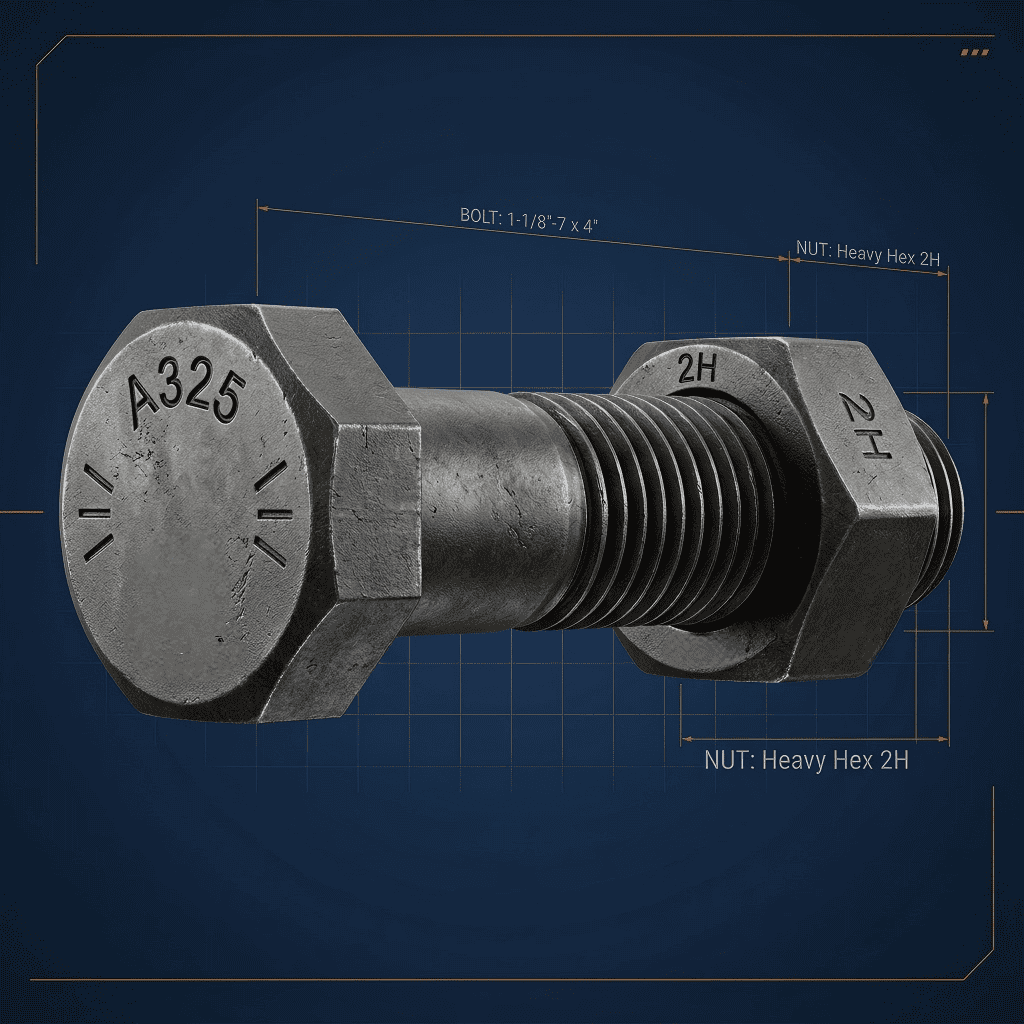
Why Bolt-to-Nut Matching Cannot Be Left to Assumption
Selecting the correct heavy hex nut for a high strength heavy hex bolt is not a formality — it is a critical engineering decision that affects joint integrity, inspection compliance, and project liability.
Many procurement teams assume that if the thread size fits, the nut is correct. In practice, a nut that physically threads onto a bolt may still be mechanically unsuitable. Grade 2H and Grade DH heavy hex nuts are not universally interchangeable, and choosing the wrong grade — even with the right thread — can result in field failure, third-party inspection rejection, or specification non-compliance.
This guide helps structural engineers, EPC buyers, plant maintenance teams, and sourcing managers understand the key matching logic, the common procurement mistakes, and exactly what to verify before placing an order.
- Thread size compatibility does not guarantee mechanical suitability — the nut grade must match the bolt specification and application requirements.
- Grade 2H and Grade DH heavy hex nuts are not automatically interchangeable in all service conditions or project specifications.
- Coating, service temperature, mechanical requirements, and project specifications all influence the correct nut selection.
- Documentation and traceability — including mill test certificates and marking — must be confirmed before ordering.
- Supplier technical review before purchase reduces mismatching risk, especially for EPC and industrial projects.
- When in doubt, verify with the applicable ASTM/ASME standard and your project engineer before finalizing the order.
Quick Matching Overview: Grade 2H vs Grade DH
Use this table as an initial reference only. Final selection must be verified against your project specification and applicable standard.
| Item | Grade 2H Heavy Hex Nut | Grade DH Heavy Hex Nut | Buyer Notes |
|---|---|---|---|
| Governing Standard | ASTM A194 Grade 2H | ASTM A194 Grade DH | Confirm project specification references correct standard |
| Typical Usage Context | Common in structural bolt assemblies, general industrial bolting | Common in high-strength structural bolt assemblies, including ASTM F3125 A490 applications | Verify against bolt grade and job specification |
| Material / Heat Treatment | Medium carbon steel, quenched and tempered | Alloy or medium carbon steel, quenched and tempered | Verify supplier MTC for actual heat treatment confirmation |
| Coating Considerations | Hot-dip galvanizing may be applied; verify thread fit after coating | Coating application must be verified against applicable standard and project specification | Verify Thread fit after coating is critical |
| Temperature / Service | Suitable for many standard service environments; verify limits with applicable standard | Verify service temperature suitability with applicable standard and project spec | Do not assume temperature suitability without verification |
| Documentation Required | MTC, mechanical test report, lot traceability, marking verification | MTC, mechanical test report, lot traceability, marking verification | Critical Do not skip for project supply |
| Sourcing Considerations | Widely available; confirm spec compliance with supplier | Confirm availability and spec compliance; lead time may vary | Confirm with supplier at RFQ stage |
| Risk If Mismatched | Inspection rejection, joint underperformance, project non-compliance, potential liability | High Risk Verify before ordering | |
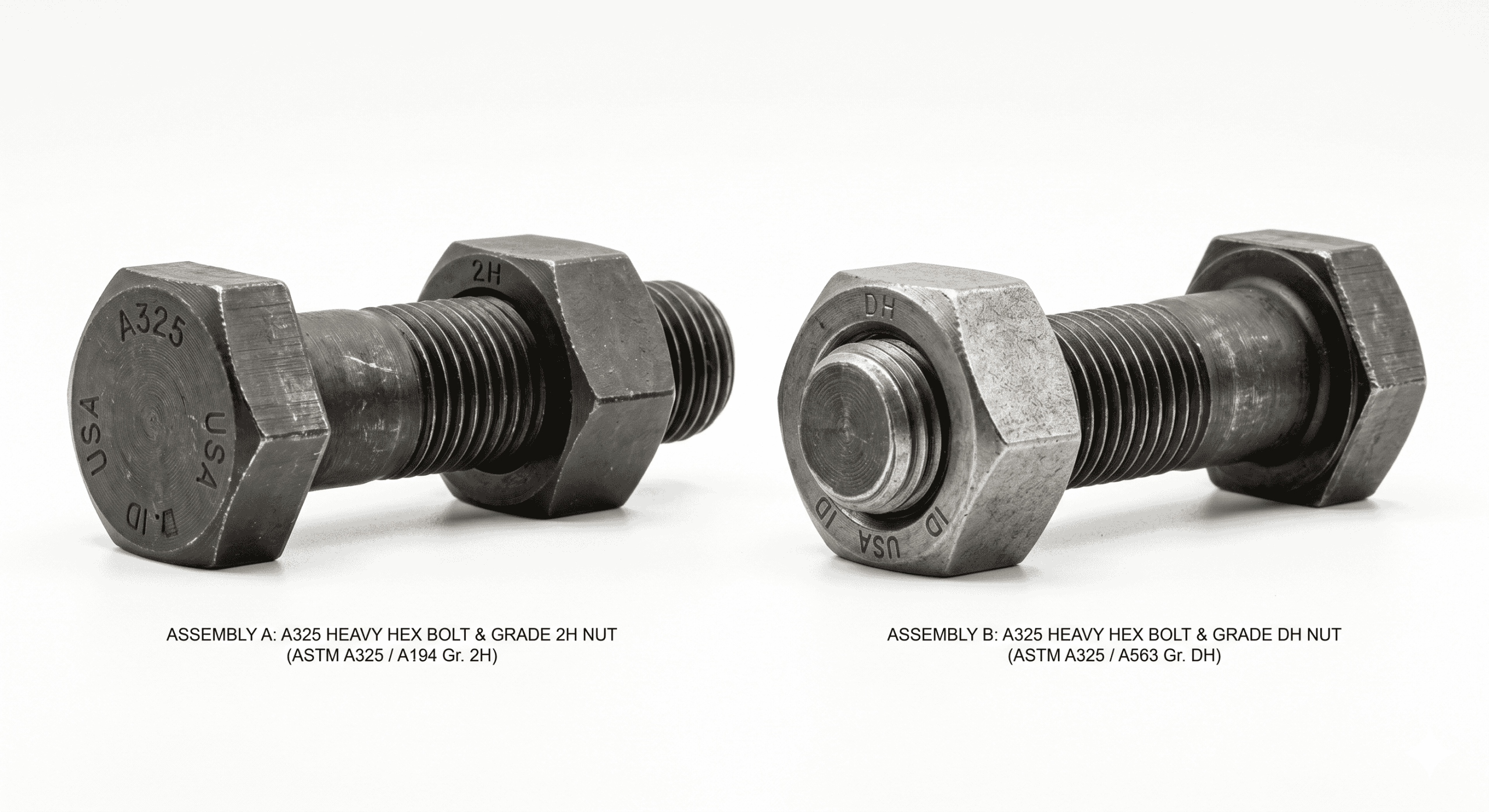
Why Matching Is Not Just About Size
One of the most common and costly assumptions in industrial fastener procurement is that if a nut threads onto a bolt, it is the correct nut for the application. This is incorrect.
Size vs. Mechanical Suitability
Thread engagement controls whether a nut physically assembles. It does not confirm that the nut provides the required proof load, hardness range, or mechanical performance for the intended joint. A nut of the wrong grade may appear to install correctly but fail to develop the required preload or perform under service loads.
The Effect of Coating, Lubrication, and Finish
Hot-dip galvanizing adds coating thickness to both the bolt and nut. After coating, thread clearances must be verified. An incorrectly sized or unverified nut may not assemble properly, or may produce unreliable torque-tension relationships during installation. Lubrication requirements must also be matched to the coating type.
Project Specifications Control the Final Choice
EPC projects, plant maintenance work, and structural steel contracts typically specify both the bolt grade and the required nut grade. Substituting one nut grade for another — even within the same size — without specification authorization creates inspection and liability risk.
| Decision Factor | Recommended Buyer Action | Why It Matters |
|---|---|---|
| High preload requirement | Verify nut proof load aligns with bolt grade and installation torque spec | Insufficient nut strength may cause joint relaxation under load |
| Elevated temperature service | Check applicable ASTM/ASME standard for temperature limits; verify with project spec | Thermal cycling may affect clamping force and material performance |
| Low temperature service | Confirm low-temperature performance requirements with applicable standard | Some nut grades may not be rated for low-temperature brittle fracture resistance |
| Refinery / plant environment | Confirm service environment requirements and verify coating and material suitability | Corrosive environments impose additional material and coating requirements |
| Coated / galvanized fasteners | Verify thread fit after coating; confirm oversized tapping if required | Coating buildup can affect assembly and torque-tension reliability |
| Maintenance / replacement work | Match original specification exactly; confirm with project or plant records | Field substitution without documentation creates inspection and liability risk |
| EPC project supply | Confirm nut grade matches project specification; do not substitute without authorization | Project specifications are legally binding; non-compliant supply may be rejected |
| Third-party inspection | Ensure all documentation — MTC, test reports, marking — is ready before inspection | Missing or incorrect documentation causes delivery delays and rejections |
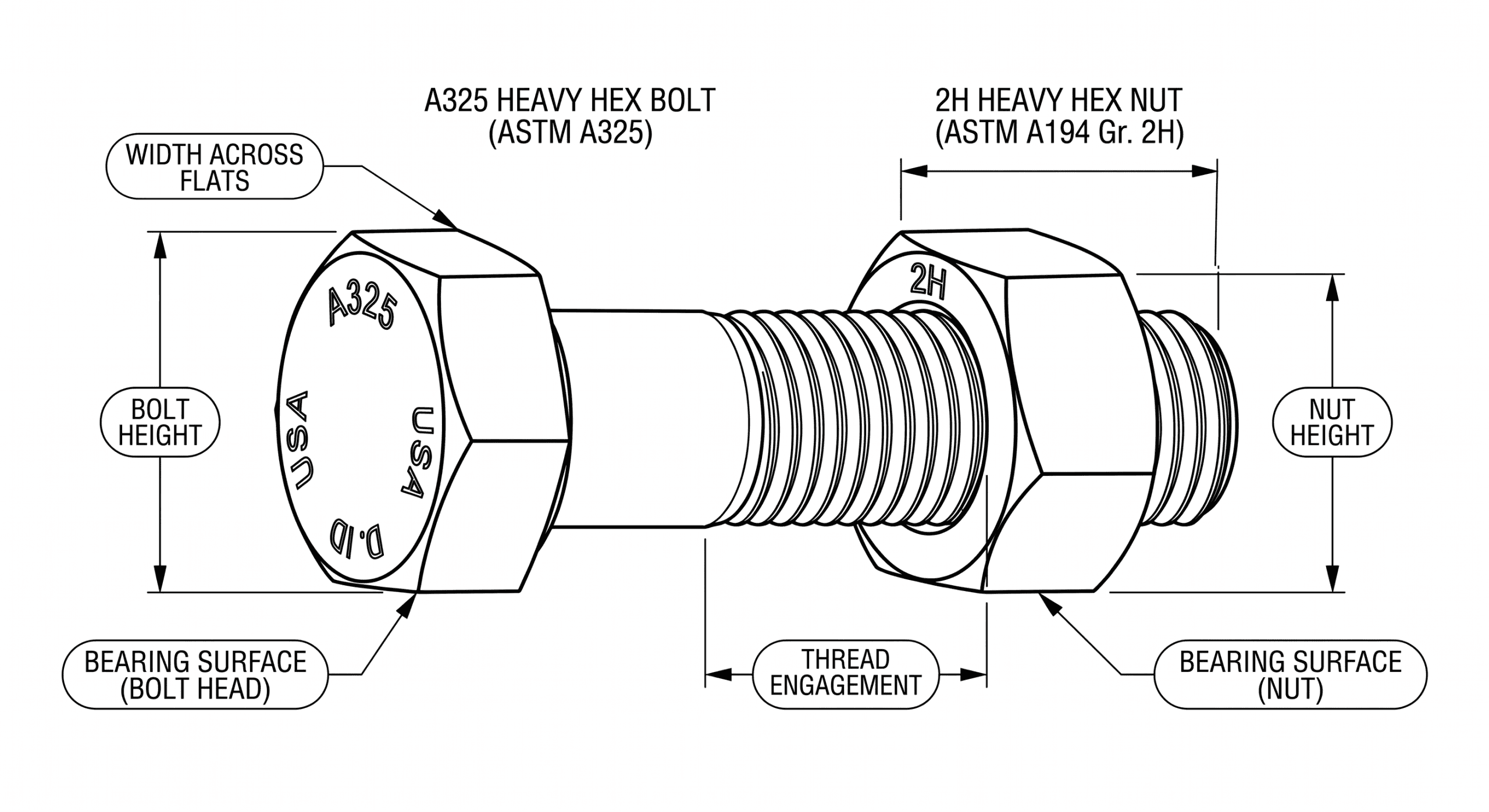
Grade 2H vs DH — What to Check Before Ordering
Grade 2H and Grade DH heavy hex nuts are both covered under ASTM A194, but they are not identical in their intended usage context, heat treatment characteristics, or project application patterns. Buyers should not treat them as equivalent alternatives without specification review.
Material and Heat Treatment Considerations
Both grades involve heat treatment processes, but the specific requirements differ. Buyers should request mill test certificates that confirm heat treatment compliance for the actual lot being supplied — not assume compliance based on grade label alone.
Documentation Matters More Than Assumptions
In project-based procurement, the governing specification will typically name the required nut grade explicitly. Buyers who substitute grades — even with similar material characteristics — without written authorization from the project engineer risk inspection rejection and supply replacement costs.
Project Specifications Override All Assumptions
When a project specification, engineering standard, or purchase order names a specific nut grade, that requirement controls. It is the buyer's responsibility to confirm that the supplied product matches — not to assume equivalence.
| Verification Point | Why It Matters | Risk If Missed |
|---|---|---|
| Bolt specification | Nut grade selection depends on what bolt grade is being used | Mechanical mismatch; joint underperformance |
| Nut grade (2H or DH) | Both are ASTM A194 grades but may have different application suitability | Specification non-compliance; inspection rejection |
| Applicable ASTM / ASME standard | Governs mechanical requirements and acceptable grades | Wrong grade supplied; non-compliant documentation |
| Thread series and fit | Thread class must match; coated fasteners require additional verification | Assembly problems; unreliable preload |
| Coating or finish | Coating type affects thread fit, lubrication, and torque-tension behavior | Installation failure; incorrect clamp force |
| Service temperature | Nut grade suitability may depend on application temperature range | Material failure in service; non-compliant selection |
| Mechanical test certification | Proof load, hardness, and material compliance must be documented | Rejection at inspection; unverifiable supply |
| Product marking and traceability | ASTM A194 requires specific marking for grade identification | Field identification failure; lot traceability loss |
| Project specification alignment | Project spec controls the final acceptable nut grade | Non-compliant supply; project rejection; replacement cost |
Common Mistakes That Cause Procurement or Installation Problems
These are the errors that experienced engineers and procurement managers encounter most often in the field. Understanding them before ordering can save significant time and cost.
- Selecting nuts based on thread size only, without verifying grade or mechanical requirements
- Assuming visual similarity between Grade 2H and Grade DH means they are technically equivalent
- Ignoring the impact of coating or galvanizing on thread fit and torque-tension behavior
- Overlooking service temperature limits when selecting nut grade
- Purchasing mixed lots from multiple sources without ensuring consistent lot traceability
- Failing to verify that the supplied nut grade matches the governing project specification
- Treating Grade 2H and DH as freely interchangeable without project engineer authorization
- Not asking the supplier to confirm the intended bolt-nut matching before ordering
| Common Error | Consequence | Prevention |
|---|---|---|
| Choosing nuts by size only | Mechanically unsuitable nut supplied; potential joint failure | Always specify and verify nut grade alongside thread size |
| Assuming visual similarity means compatibility | Wrong grade installed; inspection rejection | Check marking and request MTC before accepting supply |
| Ignoring coating effects on thread fit | Assembly problems; unreliable preload; cross-threading risk | Verify thread fit after coating; confirm oversized tapping if required |
| Skipping temperature range verification | Nut grade unsuitable for service; potential in-service failure | Verify temperature suitability with applicable standard before specifying |
| Buying mixed lots without traceability | Unverifiable supply at inspection; lot rejection | Require full lot traceability and MTC for every delivery |
| Treating 2H and DH as always interchangeable | Specification non-compliance; rejected by project inspector | Confirm which grade the project specification requires before ordering |
| Not confirming matching with supplier | Mismatched supply delivered; replacement lead time and cost | Include bolt specification in the nut inquiry and ask supplier to confirm matching |
| Skipping documentation review at delivery | Non-compliant product enters project stock undetected | Verify MTC, marking, and test reports at goods receipt, not after installation |

Procurement Checklist for B2B Buyers and Distributors
Before placing an order for high strength heavy hex bolts and matching heavy hex nuts, procurement teams should confirm all of the following items. Skipping any point — especially for project or EPC supply — significantly increases the risk of non-compliant delivery, inspection failure, or field installation problems.
| Checklist Item | What to Confirm | Why It Is Important |
|---|---|---|
| Bolt specification and grade | Exact ASTM/ASME standard and grade designation (e.g., ASTM F3125 A325, A490) | Nut selection depends on bolt grade; wrong combination creates mechanical mismatch |
| Nut grade requirement | Confirm whether Grade 2H or DH is specified by the project or governing standard | Cannot substitute grades without project engineer authorization |
| Size and thread specification | Nominal diameter, thread pitch, thread series (UNC/UNF), and thread class | Dimensional and thread class mismatch causes assembly and preload problems |
| Finish and coating | Plain, hot-dip galvanized, mechanically galvanized, or other; verify oversized tapping if coated | Coating type affects thread fit, assembly torque, and corrosion protection performance |
| Quantity and project schedule | Required quantity, delivery schedule, and phased delivery requirements if applicable | Accurate quantity and timeline prevents supply delays and partial deliveries |
| Mechanical test documentation | Request proof load test report and hardness verification for the supplied lot | Mechanical compliance cannot be assumed from grade label alone |
| Mill test certificate (MTC) | Confirm MTC is available for the supplied lot, identifying heat, material, and test results | Required for third-party inspection and project documentation packages |
| Product marking | Verify that nuts carry correct grade marking as required by ASTM A194 | Missing or incorrect marking causes field identification failure and lot rejection |
| Lot traceability | Confirm that the supplier can trace each lot from raw material to finished product | Traceability is required for most industrial and project-based fastener supply |
| Export and packaging requirements | Confirm packaging type, labeling, export marks, and destination requirements | Incorrect packaging or labeling causes customs delays and delivery problems |
| Third-party inspection requirement | Confirm whether TPI is required; coordinate inspector access with supplier before order | Last-minute TPI requests delay shipment and may require additional supplier preparation |
| Project specification compliance | Confirm that the supplied product meets all requirements in the governing project specification | Project spec governs final acceptance; non-compliant supply is rejected regardless of standard compliance |
Inquiry Recommendations: How to Get a Faster and More Accurate Quote
The quality of an RFQ directly affects the speed and accuracy of the quotation. Vague or incomplete inquiries result in back-and-forth communication, incorrect quotes, and delivery delays. The following guidance helps buyers prepare a more complete and effective inquiry.
What to Include in Your Inquiry
- The bolt standard, grade, and diameter — nut selection cannot be quoted accurately without this
- The required nut grade (Grade 2H or DH) as specified by the project or engineer
- Thread diameter, pitch, thread series, and thread class
- Required finish or coating type, and whether oversized tapping is required
- Application environment (structural, piping, refinery, heavy equipment, etc.)
- Quantity required and preferred delivery schedule
- Required documentation: MTC, mechanical test reports, marking confirmation
- Destination country and any import or customs requirements
- Packaging requirements and export marks if applicable
- Whether third-party inspection is required, and if so, which inspection body
| RFQ Item | Example | Why It Helps |
|---|---|---|
| Bolt specification | ASTM F3125 Grade A325 heavy hex structural bolt | Supplier can confirm correct nut grade for the bolt being matched |
| Nut grade requested | ASTM A194 Grade 2H heavy hex nut | Eliminates grade ambiguity; prevents wrong grade supply |
| Size and thread | 1 inch diameter, UNC thread, 8 threads per inch, Class 2B | Enables accurate dimensional and threading confirmation by supplier |
| Finish / coating | Hot-dip galvanized per ASTM A153; oversized tapping required | Prevents coating and thread fit problems at delivery |
| Application environment | Petrochemical plant, ambient temperature, flanged piping connections | Helps supplier flag any material or coating compatibility concerns |
| Quantity | 5,000 pieces (bolt and nut sets) | Enables accurate lead time and pricing; prevents partial delivery issues |
| Required documents | MTC, mechanical test report, dimension inspection report, packing list | Supplier can prepare documentation package in advance; no delays at delivery |
| Destination country | United States — port of Houston, Texas | Enables accurate freight planning and export documentation preparation |
| Packaging requirement | Bulk in plywood cases, max 25 kg per case, English labels | Prevents packaging non-conformance at customs or warehouse receipt |
| Inspection requirement | Third-party inspection required before shipment; Bureau Veritas | Supplier can coordinate inspector access and avoid last-minute shipment delays |
Application Scenarios Where Correct Matching Matters Most
The following industrial applications represent environments where incorrect bolt-to-nut matching creates the greatest engineering risk, inspection exposure, or project liability.
| Application Scenario | Matching Priority | Main Buyer Concern | Notes |
|---|---|---|---|
| Petrochemical plants | Critical | Specification compliance, MTC, lot traceability | Process safety standards impose strict fastener documentation requirements |
| Pressure piping systems | Critical | Governing standard, proof load verification, coating suitability | ASME B31.3 and related codes may govern fastener selection; verify with project engineer |
| Valve and flange assemblies | Critical | Dimensional accuracy, preload consistency, coating after tapping | Flange bolt patterns require consistent torque-tension across all fasteners |
| Structural steel connections | High | AISC / project specification compliance, grade marking verification | Structural bolt assemblies must meet AISC requirements; verify nut grade per spec |
| Heavy equipment assembly | High | Mechanical performance, thread engagement depth, vibration resistance | High-vibration environments require verified preload capability |
| Energy facility projects | Critical | Full documentation package, traceability, TPI access | Power generation and energy projects often require extensive QC documentation |
| Plant maintenance replacement | High | Exact grade match with original specification, coating match | Maintenance substitutions must match original spec; verify against plant records |
| North American EPC projects | Critical | Project spec compliance, TPI, export documentation, on-time delivery | EPC procurement often involves multiple layers of specification review and inspection |
How to Order / Quick Specs
QISHENG supplies high strength heavy hex bolts and matching heavy hex nuts to North American EPC contractors, industrial distributors, and project procurement teams. We support technical inquiries, documentation packages, and customized supply requirements.