

DIN 931 vs DIN 933: Understanding Partial Thread and Full Thread Hex Bolts for Critical Industrial Applications
A structural failure in a heavy manufacturing assembly line can cost thousands of dollars per hour in downtime. The root cause? An incorrectly specified hex bolt. Procurement managers and mechanical engineers routinely face a deceptively simple choice: DIN 931 or DIN 933. Both are metric hex head bolts. Both appear similar. Yet their threading differences create fundamentally different load distributions, shear plane behaviors, and failure modes. Selecting the wrong standard can compromise joint integrity in high-vibration environments, dynamic loading conditions, or temperature-cycled assemblies. This technical guide clarifies the mechanical, dimensional, and application distinctions between these two European standards now widely adopted across North American industries.

Core Technical Differences: Thread Length and Mechanical Implications
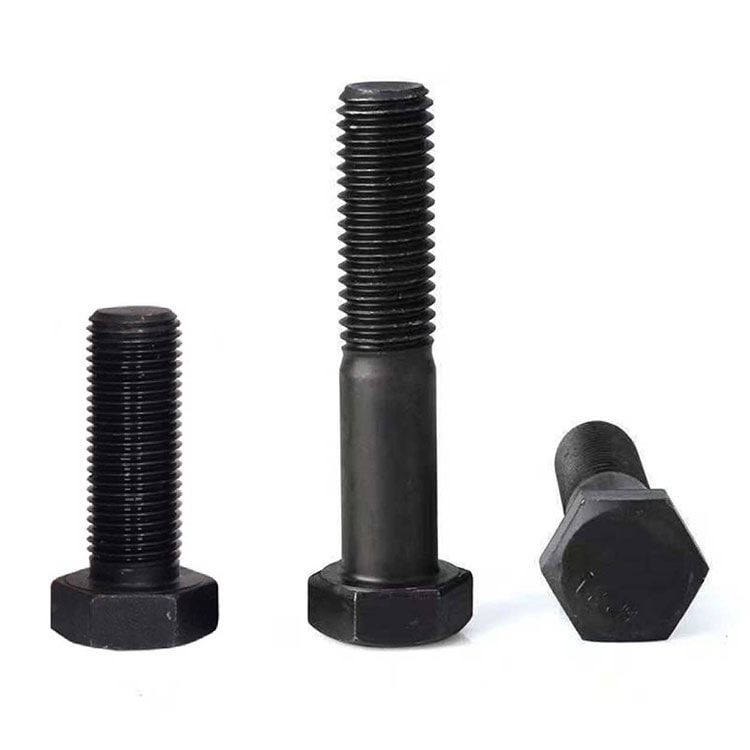
The primary distinction between DIN 931 and DIN 933 lies in thread length. DIN 931 specifies a partial thread configuration. The threaded portion extends from the bolt tip upward to a defined length that varies with nominal diameter and total bolt length. The remaining shank under the head remains unthreaded. DIN 933, by contrast, mandates full threading from the tip to the underside of the hex head.

Detailed chart of DIN 931 and DIN 933 fastener specifications for engineering projects.
This seemingly minor difference has significant mechanical consequences. When a DIN 931 bolt is installed in a through-hole joint, the smooth shank section can be positioned to align with the shear plane. The unthreaded shank has a larger effective cross-sectional area than a threaded section of the same nominal diameter. This increases the bolt’s resistance to shear forces. Threads act as stress concentrators. A shear plane intersecting threads experiences localized stress intensification at the thread roots, reducing effective shear strength by approximately 20-25% compared to a smooth shank.
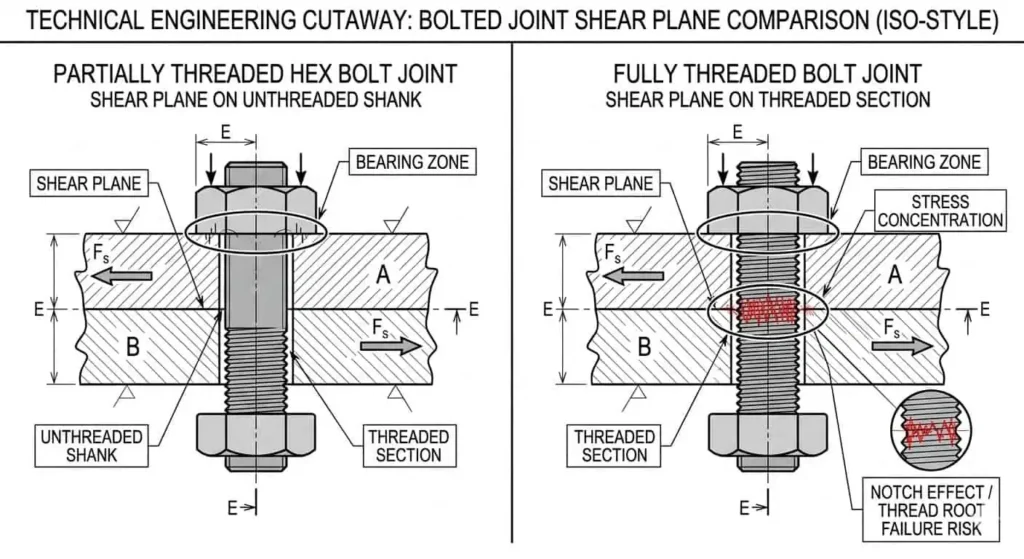
DIN 933 bolts, being fully threaded, cannot avoid thread engagement at the shear plane unless washers or spacers artificially position the smooth head-to-shank transition at the critical interface. This makes DIN 933 more suitable for tension-dominant applications where clamping force and preload are the primary design criteria. DIN 931 is preferred in shear-critical joints such as structural steel connections, machinery mounts, and heavy equipment assemblies.
Technical Similarities: Head markings, Material and Heat Treatment
Head Markings and Material Identification
Both DIN 931 and DIN 933 bolts manufactured to property class standards (per ISO 898-1) carry identical head markings. A property class 8.8 bolt will display “8.8” on the head regardless of thread configuration. The manufacturer’s symbol may also appear. These markings confirm minimum tensile strength (800 MPa) and yield strength (640 MPa). Property class 10.9 bolts, common in high-stress applications, exhibit 1000 MPa tensile strength and 900 MPa yield strength. Head markings do not differentiate between DIN 931 and DIN 933. Dimensional inspection of thread length is required.
Material Chemistry and Heat Treatment
Both standards are produced from low-carbon or medium-carbon alloy steels. Typical chemistries for property class 8.8 include carbon content between 0.25-0.55%, manganese 0.60-1.00%, and trace amounts of chromium, nickel, and molybdenum to enhance hardenability. Property class 10.9 bolts use higher carbon steels (0.30-0.55%) with controlled alloy additions. Heat treatment involves quenching and tempering to achieve the specified mechanical properties. Post-treatment, bolts may receive zinc plating (per ISO 4042), hot-dip galvanizing (ISO 1461), or mechanical galvanizing for corrosion resistance. Hydrogen embrittlement risk exists for high-strength fasteners (≥10.9) subjected to electroplating. Baking cycles per ASTM F1941 or ISO 9587 are mandatory.
Detailed Specification Comparison Table
| Parameter | DIN 931 (Partial Thread) | DIN 933 (Full Thread) |
|---|---|---|
| Thread Configuration | Partial thread; unthreaded shank under head | Full thread from tip to head underside |
| Thread Length (M12 x 60mm example) | Approximately 34mm threaded, 26mm smooth shank | 60mm fully threaded |
| Shear Plane Optimization | Smooth shank can align with shear plane for higher shear strength | Threads likely at shear plane; reduced shear capacity |
| Tensile Strength (Property Class 8.8) | 800 MPa minimum per ISO 898-1 | 800 MPa minimum per ISO 898-1 |
| Proof Load (Property Class 8.8, M12) | ~52.7 kN (based on stress area 84.3 mm²) | ~52.7 kN (based on stress area 84.3 mm²) |
| Yield Strength (Property Class 8.8) | 640 MPa minimum | 640 MPa minimum |
| Head Marking | Property class (e.g., 8.8, 10.9) + manufacturer symbol | Property class (e.g., 8.8, 10.9) + manufacturer symbol |
| Typical Applications | Structural steel, machinery frames, shear-critical joints | Flanged connections, tension joints, equipment assembly |
| Thread Tolerance | 6g per ISO 965-1 (medium tolerance) | 6g per ISO 965-1 (medium tolerance) |
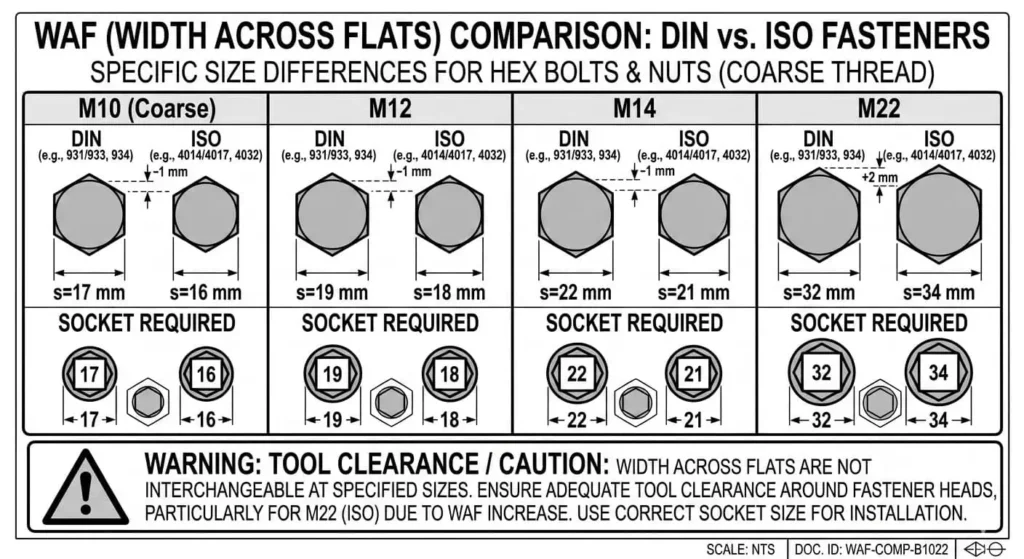
| Head Dimensions (Across Flats, M12) | 19mm (ISO 4014/4017 reference) | 19mm (ISO 4017 reference) |
| Surface Finish Options | Zinc plated, hot-dip galvanized, black oxide, plain | Zinc plated, hot-dip galvanized, black oxide, plain |
Critical Note on Tensile vs. Shear: While both standards share identical tensile strength ratings when manufactured to the same property class, the effective shear strength differs due to thread engagement at the shear plane. Engineers must calculate shear capacity based on the actual cross-section at the critical plane. For DIN 931, this is typically the unthreaded shank diameter. For DIN 933, use the thread’s minor diameter or stress area.
Industry Applications Across North American Markets
North American industries have widely adopted metric fasteners alongside traditional ASME B18.2.1 inch-series bolts. DIN 931 and DIN 933 are specified in sectors ranging from heavy civil infrastructure to precision machinery manufacturing.
United States Industrial Infrastructure
DIN 931 bolts are prevalent in structural steel construction. Bridge assemblies, building frames, and industrial platforms utilize partial-thread bolts to position the smooth shank at beam-to-column connections. The unthreaded section resists shear forces from wind loading, seismic activity, and live loads. Heavy equipment manufacturers (agricultural machinery, mining equipment, construction vehicles) specify DIN 931 for mounting engine blocks, transmission housings, and chassis components where vibration and dynamic shear are concerns.
DIN 933 bolts find application in flanged piping systems, pressure vessel assembly, and equipment installation where gasket compression and clamping force are critical. The full threading allows for flexible grip length adjustment without concern for thread run-out. Maintenance teams prefer DIN 933 in applications requiring frequent disassembly, as the extended threading provides more engagement options.
Canadian Cold-Climate and Resource Sector Demands
Canada’s extreme temperature ranges and resource extraction industries impose additional fastener requirements. Mining operations in northern regions subject bolts to thermal cycling between -40°C and +30°C. Low-temperature impact toughness becomes a specification criterion. DIN 931 bolts in property class 8.8 with controlled sulfur content and fine-grain microstructures maintain ductility at sub-zero temperatures. Oil sands equipment, forestry machinery, and hydroelectric infrastructure rely on **heavy-duty hex bolts** meeting both DIN dimensional standards and supplementary cold-service certifications.
Offshore platforms in the Atlantic provinces and Arctic drilling operations specify hot-dip galvanized DIN 933 bolts for corrosion resistance in marine environments. The full threading ensures maximum thread engagement in thick flanges and structural connections where salt spray and moisture penetration are constant threats.

Sourcing and Quality Control: What Procurement Managers Must Verify
Specifying DIN 931 or DIN 933 is only the first step. Ensuring delivered fasteners meet dimensional tolerances, mechanical properties, and material certifications requires rigorous incoming inspection protocols.
Dimensional Verification
Thread pitch gauges (GO/NO-GO) confirm conformance to ISO 965-1 tolerance class 6g. A GO gauge must thread freely onto the bolt. A NO-GO gauge must not advance more than two thread turns. Measure thread length with calipers or depth micrometers. For DIN 931, verify the transition point between threaded and unthreaded sections matches the standard’s formula (typically 2d + 6mm for bolts under 125mm length, where d is nominal diameter).
Across-flats (AF) dimensions must align with ISO 4014/4017. A 19mm socket must fit an M12 hex head without play or force. Head height, shank diameter, and overall length require verification against tolerance bands specified in the standard.
Mechanical Property Testing
Request Material Test Certificates (MTC) per EN 10204 Type 3.1. These documents, issued by the manufacturer and certified by an independent inspector, detail tensile test results, hardness measurements (typically Rockwell or Vickers), and chemical composition via spectrographic analysis. Tensile tests must demonstrate minimum breaking load, proof load, and elongation percentages per ISO 898-1.
For critical applications, conduct wedge tensile testing per ASTM F606 Method 1. This test applies axial tension until bolt failure, confirming the fastener meets its property class rating. Hardness testing (HRC or HV) should fall within the specified range (e.g., HRC 22-32 for property class 8.8).
Coating and Corrosion Resistance Validation
Zinc plating thickness is measured via X-ray fluorescence (XRF) or magnetic induction gauges. ISO 4042 specifies minimum coating weights (e.g., 5 µm for standard service). Hot-dip galvanized bolts per ISO 1461 require minimum 45 µm average thickness. Salt spray testing per ASTM B117 validates corrosion resistance duration (typically 96-720 hours depending on coating type).
Traceability Requirement: Each production lot should carry a unique identifier linking back to heat treatment records, raw material certifications, and test reports. This traceability is mandatory for aerospace, nuclear, and pressure vessel applications governed by ASME or API standards.
Reliable Sourcing for Bulk B2B Orders
Identifying a supplier capable of delivering consistent quality, accurate certifications, and on-time logistics is a persistent challenge for North American procurement teams. Domestic distributors often carry limited inventory in non-standard lengths or property classes. Direct sourcing from manufacturers offers cost advantages and customization options but requires due diligence.
QISHENG (Jiangyin Qi Sheng International Trading Co., Ltd.) specializes in supplying DIN 931 and DIN 933 hex bolts to the North American market. With ISO 9001 certified manufacturing partners and in-house quality control laboratories, QISHENG provides full material traceability, third-party inspection reports, and compliance with ASTM, SAE, and ISO mechanical property standards. The company maintains inventory in property classes 4.6, 8.8, and 10.9 across diameters from M6 to M36, with custom lengths and surface treatments available for bulk orders.
For projects requiring specific thread length configurations, non-standard materials (such as A2 or A4 stainless steel per ISO 3506), or expedited delivery to job sites across the United States and Canada, sourcing managers can **contact our fastener experts** for technical consultation and quotation. QISHENG’s logistics network ensures container shipments to major ports (Los Angeles, Houston, Vancouver, Montreal) with options for less-than-container-load (LCL) orders and distribution center stocking programs.
The choice between DIN 931 and DIN 933 is not arbitrary. It reflects an engineering decision rooted in load analysis, joint design, and failure mode prediction. Partial-thread DIN 931 bolts optimize shear resistance in structural and machinery applications. Full-thread DIN 933 bolts maximize clamping versatility in tension-dominated assemblies. Both standards demand rigorous quality control, dimensional verification, and material certification to ensure reliability in service. North American industries benefit from understanding these distinctions and partnering with suppliers who prioritize technical accuracy and traceability. Whether specifying fasteners for a bridge retrofit in Ohio or a mining operation in Alberta, the correct bolt choice—and the correct supplier—determines long-term performance and safety. For comprehensive technical support and certified bulk supply, **reach out to QISHENG** to discuss your project requirements.