

Heavy Hex Bolt and Nut: ASTM A325 vs A490 vs F3125—What’s the Difference?
1. Introduction
In the world of structural engineering and commercial construction, the integrity of a massive steel framework often comes down to the smallest components: the fasteners. Heavy hex structural bolts and nuts are the critical elements holding together skyscrapers, suspension bridges, industrial manufacturing plants, and heavy-duty transmission towers.
For decades, project engineers, contractors, and fastener distributors have relied on two primary structural bolting specifications: ASTM A325 and ASTM A490. These two standards served as the absolute benchmarks for structural bolting. However, in 2015, the fastener industry experienced a major regulatory shift when the American Society for Testing and Materials (ASTM) introduced ASTM F3125, a consolidated umbrella standard that reorganized how these structural bolts are classified and ordered.
This transition has left many buyers and procurement teams asking: Are A325 and A490 still valid? What exactly changed? And how do I ensure I am sourcing the correct fastener for my project requirements?
This comprehensive technical guide will clarify the definitions, compare the key differences in strength, metallurgy, and coating limitations, and provide a clear overview of the transition to ASTM F3125. Whether you are an EPC contractor procuring materials for a bridge or an engineer finalizing a joint design, understanding these differences is essential for safety, code compliance, and successful project execution.
2. What Are Heavy Hex Bolts and Nuts?
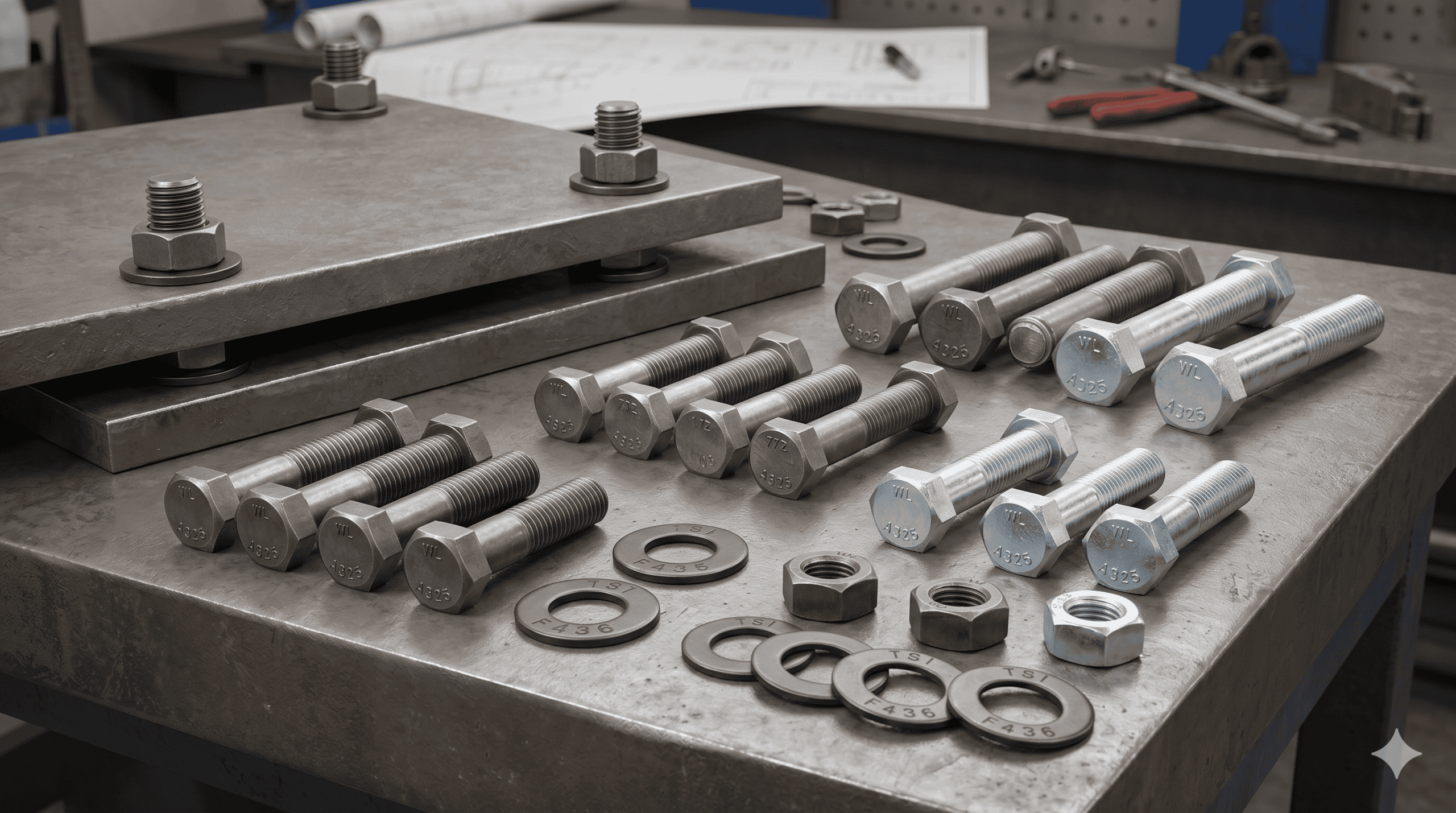
Before diving into the complex ASTM specifications, it is crucial to understand what distinguishes a "heavy hex" bolt and nut from standard hexagonal fasteners.
A heavy hex bolt features a head that is significantly larger and thicker than that of a standard hex bolt. Specifically, the width across the flats (the distance from one flat side of the hexagon head to the opposite flat side) is generally 1/8 inch larger than standard hex bolts of the same nominal diameter. The heavy hex nut is similarly oversized, presenting a thicker profile and a broader bearing surface.
This increased dimension is not merely for aesthetics; it serves a fundamental engineering purpose. The wider head and nut provide a substantially larger bearing area under the head and the nut face. This wider footprint distributes the clamping load over a broader area of the connected structural steel, reducing the bearing stress on the steel members. This is especially vital in structural applications involving oversized or slotted holes, which are common in steel construction to accommodate alignment tolerances.
Due to their robust design and load-bearing capabilities, heavy hex bolts and nuts are the standard choice for high-strength structural connections in building frameworks, bridges, highway structures, and heavy industrial equipment.
3. Overview of ASTM A325, ASTM A490, and ASTM F3125
To navigate the procurement of structural fasteners today, you must understand both the historical specifications and the current regulatory landscape.
What Was ASTM A325?
For over half a century, ASTM A325 was the standard specification for high-strength structural bolts made from heat-treated medium carbon or carbon alloy steel. Providing a minimum tensile strength of 120 ksi (for sizes up to 1 inch), A325 bolts became the workhorse of the steel construction industry. They were widely used in standard steel-to-steel connections in buildings, basic bridges, and general structural framework where extreme high tension was not the sole requirement.
What Was ASTM A490?
ASTM A490 was developed for applications requiring higher strength than what A325 could provide. Manufactured from heat-treated alloy steel, A490 bolts offer a minimum tensile strength of 150 ksi. These fasteners were reserved for heavy-duty applications—such as high-rise buildings, long-span bridges, and structures subjected to extreme loads or fatigue where maximum clamping force and shear resistance were necessary.
What Is ASTM F3125?
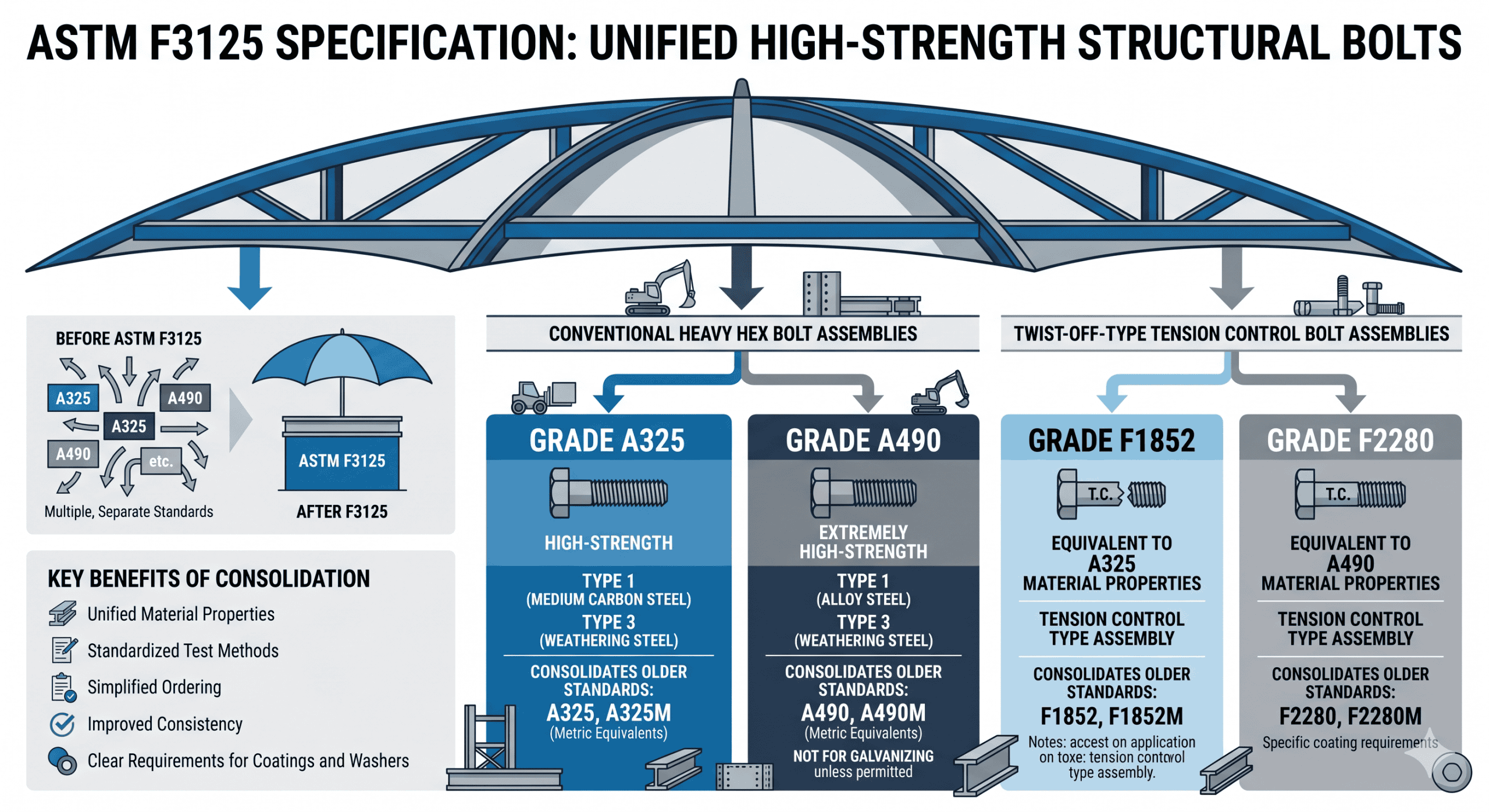
In 2015, the ASTM committee recognized that maintaining multiple separate standards for structural bolts (including imperial sizes, metric sizes, and twist-off control bolts) was becoming administratively cumbersome and prone to discrepancies. The solution was ASTM F3125.
ASTM F3125 is a unified, umbrella specification that consolidated six previously separate structural bolt standards: A325, A325M (metric), A490, A490M (metric), F1852 (twist-off A325 equivalents), and F2280 (twist-off A490 equivalents).
Crucial Takeaway: ASTM A325 and A490 did not disappear. Instead, they were absorbed into the new standard. Today, they are technically ordered as Grades under the F3125 specification—namely, ASTM F3125 Grade A325 and ASTM F3125 Grade A490. While engineers and buyers still frequently refer to them colloquially as "A325 bolts" or "A490 bolts," modern purchase orders and test reports will officially reflect the F3125 designation.
4. ASTM A325 vs A490 vs F3125: Key Differences
While F3125 is the governing standard for both, Grades A325 and A490 remain fundamentally different in their physical and mechanical properties. Choosing the wrong grade can lead to structural failure or costly code violations.
The following table and subsequent sections break down the primary engineering and commercial distinctions between these structural fasteners.
| Feature / Property | Grade A325 (Now F3125 Gr. A325) | Grade A490 (Now F3125 Gr. A490) |
|---|---|---|
| Tensile Strength (Min) | 120 ksi (up to 1"); 105 ksi (over 1") *Note: F3125 updated this to 120 ksi across all sizes. | 150 ksi (all sizes) |
| Maximum Tensile Strength | Not specified | 173 ksi (to prevent brittle failure) |
| Material | Medium Carbon, Carbon Boron, or Alloy Steel | Alloy Steel only |
| Hot-Dip Galvanizing | Allowed (commonly galvanized) | Strictly Prohibited (Hydrogen Embrittlement risk) |
| Electroplating | Allowed | Strictly Prohibited |
| Cost Level | Moderate / Standard | Higher (due to alloy material & heat treatment) |
| Typical Application | Standard structural steel connections, general buildings | Heavy dynamic loads, high-rise, heavy infrastructure |
5. Strength and Mechanical Performance
The primary reason an engineer will specify A490 over A325 is the requirement for greater strength and clamping force.
Grade A325 bolts offer a minimum tensile strength of 120,000 psi (120 ksi). This provides ample clamping force for the vast majority of standard steel structural joints, allowing the joint to rely on friction (slip-critical joints) or bearing to support loads.
Grade A490 bolts push the minimum tensile strength up to 150,000 psi (150 ksi). This roughly 25% increase in strength allows engineers to either support much heavier loads with the same number of bolts or reduce the total number of bolts required for a connection, which can save space and fabrication time on massive joints.
However, higher strength is not always universally better. As steel strength increases, ductility decreases. Because A490 bolts are so hard, they are more susceptible to brittle failure under certain conditions. For this reason, ASTM standards place a maximum tensile strength limit of 173 ksi on A490 bolts to ensure they retain enough ductility to yield slightly rather than snapping catastrophically when overloaded.
6. Material and Coating Differences
One of the most critical, frequently misunderstood differences between A325 and A490 lies in how they can be coated for corrosion resistance. This is a vital commercial and engineering consideration for outdoor or marine construction.
Material Composition
A325 bolts can be manufactured from medium carbon steel, carbon boron steel, or medium carbon alloy steel, provided they meet the heat treatment and mechanical requirements. A490 bolts, on the other hand, must be manufactured exclusively from high-quality alloy steel to achieve their 150 ksi strength.
The Coating and Galvanizing Dilemma
If you are building a bridge over saltwater, you need corrosion protection.
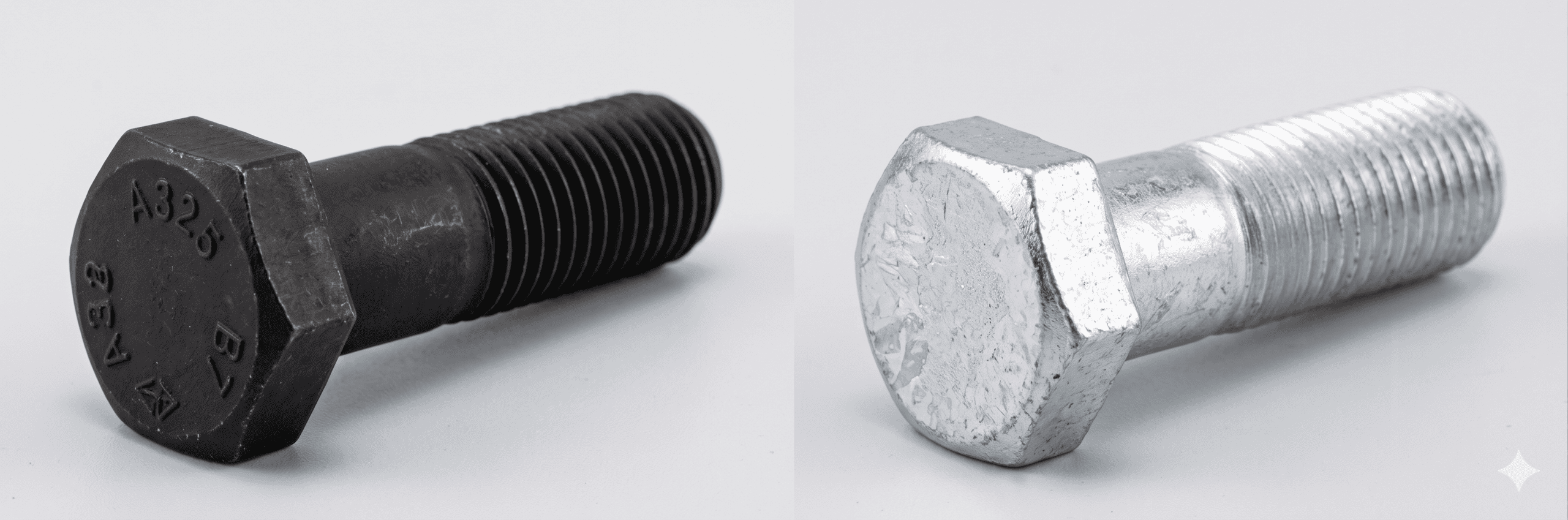
For Grade A325 bolts, hot-dip galvanizing (per ASTM F2329) or mechanical galvanizing (per ASTM B695) is standard practice. They readily accept zinc coatings without compromising their structural integrity.
For Grade A490 bolts, hot-dip galvanizing and standard electroplating are explicitly forbidden by ASTM standards. This restriction is due to a dangerous phenomenon known as Hydrogen Embrittlement. The high-strength alloy steel used in A490 bolts is highly susceptible to absorbing atomic hydrogen during the acid pickling and plating/galvanizing processes. Once absorbed, the hydrogen causes microscopic internal pressure, causing the bolt to suddenly and violently crack under tension, often days or weeks after installation.
If corrosion resistance is required for A490 bolts, engineers must specify protective coatings that do not introduce hydrogen risk, such as Zinc/Aluminum Inorganic coatings (ASTM F1136) or other approved proprietary zinc-flake coatings.
7. Nuts and Washer Compatibility
A high-strength bolt is useless if paired with an inadequate nut or washer. The entire assembly must be compatible to achieve the required tension. Heavy hex structural bolts are engineered to be installed as a complete, matched set.
Matching Heavy Hex Nuts
- For Grade A325: Typically paired with ASTM A563 Grade C, C3, D, DH, or ASTM A194 Grade 2H heavy hex nuts. If the A325 bolt is galvanized, it must be paired with an A563 Grade DH or A194 2H nut that is also galvanized, and the nut must be overtapped and lubricated to accommodate the thickness of the zinc coating on the bolt threads.
- For Grade A490: Due to the higher strength of the bolt, the nut must also be exceedingly strong to prevent the threads from stripping during torquing. A490 bolts must be paired with ASTM A563 Grade DH or ASTM A194 Grade 2H heavy hex nuts. Standard grade nuts will fail well before the A490 bolt reaches its required tension.
Hardened Washers
Both grades require the use of hardened steel washers manufactured to the ASTM F436 specification. Standard flat washers will deform or crush under the extreme clamping pressure generated by heavy hex structural bolts. The F436 washer prevents galling of the connected steel and ensures accurate torque-to-tension relationships.
8. Applications: When to Use A325, A490, or F3125 Grades
Selecting the right grade requires a thorough assessment of load requirements, environmental conditions, and structural design codes.
Use ASTM F3125 Grade A325 when:
- Erecting standard low-to-mid-rise commercial steel buildings.
- Constructing manufacturing facilities and warehouses.
- Building standard highway overpasses and pedestrian bridges.
- The project requires extensive hot-dip galvanizing for harsh outdoor weather exposure.
Use ASTM F3125 Grade A490 when:
- Erecting high-rise skyscrapers subjected to massive wind and dead loads.
- Constructing heavy-duty rail bridges or long-span suspension bridges.
- Building industrial power plants or heavy equipment support structures.
- Space constraints demand maximum load transfer through the smallest possible joint footprint.

9. ASTM F3125: Why the Standard Changed
It is worth reiterating why the fastener industry moved to F3125, as this remains a point of confusion for many procurement officers.
Prior to 2015, if a contractor needed structural bolts, they had to navigate ASTM A325 for imperial bolts, A325M for metric, F1852 for tension-control versions, and similarly for A490. Furthermore, there was a confusing rule regarding A325 bolts over 1 inch in diameter, which historically dropped in required tensile strength from 120 ksi to 105 ksi.
The F3125 consolidation solved this. It unified the language, streamlined the testing procedures, and, importantly, standardized the tensile strength of Grade A325 bolts to 120 ksi across all sizes. It made the job of engineers, quality control inspectors, and fastener manufacturers much simpler while preserving the trusted performance of the original grades.
10. Buying Guide for Heavy Hex Bolt and Nut Sets
Procuring structural fasteners is a rigorous process. A single rejected batch of bolts can halt a multi-million-dollar steel erection project. When submitting requests for quotation (RFQs) or purchase orders, buyers should clearly define the following parameters:
- Current Specification: Specify "ASTM F3125 Grade A325" or "Grade A490" to show compliance with modern standards.
- Nut & Washer Matching: Explicitly request the appropriate ASTM A563/A194 nuts and F436 washers. It is safer to buy these as assembled sets from the same manufacturer to ensure thread fit and coating compatibility.
- Diameter and Length: Ensure the grip length is calculated correctly to allow for proper thread engagement through the steel plies and washers.
- Coating/Finish: Specify Plain, Hot-Dip Galvanized, or Zinc-Flake. Remember, NEVER request hot-dip galvanizing for A490.
- Documentation: Always require a Material Test Report (MTR). This document proves the chemical composition, heat treatment, and mechanical testing results comply with ASTM standards. Without an MTR, a structural bolt is just a piece of metal.
How to Order / Quick Specs
QISHENG is a professional supplier of high-strength heavy hex bolts and matching heavy hex nut assemblies. We support EPC contractors, industrial fastener distributors, and project procurement teams with reliable manufacturing, comprehensive technical documentation, and customized supply chain solutions for global structural projects.
Available Standards
ASTM F3125 (Grades A325 & A490)
ASTM A194 Grade 2H / A563 DH
Customization
Thread sizing, specialty grades, advanced coatings, custom head markings, and export packaging.
Documentation (MTR)
Full Material Test Certificates (MTC), mechanical test reports, dimension inspections, and detailed packing lists.
Export Support
North American market experience, seamless port documentation, and Third-Party Inspection (TPI) coordination.
Inquiry Details to Prepare
Bolt spec, nut grade, diameter/length, coating type, quantity, destination port, and required certifications.
Technical Support
Available before ordering if project specifications, nut matching, or coating requirements are not yet finalized.
11. Conclusion
While standard hex bolts suffice for general hardware needs, structural steel demands the robust performance of heavy hex bolts and nuts. The key difference between ASTM A325 and ASTM A490 boils down to strength, metallurgy, and coating limitations. Grade A325 (120 ksi) serves as the reliable, easily galvanized standard for most structural joints, while Grade A490 (150 ksi) provides the extreme high strength required for heavy-duty infrastructure—with strict prohibitions against hot-dip galvanizing.
Understanding that these historic standards now live under the unified ASTM F3125 specification ensures your procurement terminology remains modern and accurate. By accurately matching bolt grades with compatible nuts, F436 washers, and appropriate finishes, you guarantee a safe, code-compliant, and durable structural connection for your next major construction project.
12. FAQ
Is ASTM A325 still valid?
Yes, but the terminology has shifted. A325 is no longer a standalone standard; it is now officially recognized as a Grade under the consolidated ASTM F3125 standard (i.e., ASTM F3125 Grade A325). The physical bolts and their performance remain the same.
Is A490 stronger than A325?
Yes. A490 bolts have a minimum tensile strength of 150 ksi and are made from alloy steel, whereas A325 bolts have a minimum tensile strength of 120 ksi and are typically made from medium carbon steel.
What is ASTM F3125?
ASTM F3125 is the modern umbrella specification created in 2015 that consolidated six previously separate structural bolt standards, including A325, A490, and their metric and twist-off equivalents, to simplify structural fastener procurement and engineering.
Can A490 bolts be galvanized?
No. ASTM strictly prohibits hot-dip galvanizing and standard electroplating for A490 bolts due to the high risk of hydrogen embrittlement, which can cause catastrophic brittle failure in high-strength alloy steel. Alternative non-electrolytic zinc flake coatings must be used if corrosion resistance is required.
Are heavy hex nuts different from standard hex nuts?
Yes. Heavy hex nuts are 1/8 inch wider across the flats than standard hex nuts of the same diameter. This larger size provides a wider bearing surface, which better distributes heavy clamping loads and prevents the nut from pulling through structural steel connections.